Waterfall
When we built the pond we ended up with a few tons
of clay soil from digging the main hole for the pond.
We used this to form the rockery and waterfall.
I dug the ground and built it up to form the steps
for the waterfall area, and smoothed out the bottom
(ours is fairly solid clayish soil which meant it
stayed in the form I made it).
One of the key things
with the waterfall, was to
make sure the pond liner had plenty of overlap
with each consecutive section. If
you can, try to do it in one piece. See notes on
this later on. Be sure you
measure and then add plenty extra when you are
buying your liner. If you don't allow enough
you will have wasted your money!
We found it impractical to use one piece,
because of the turn
in the waterfall, and pushing the liner into the
shape of the steps. Whatever you do, don't cut
the PVC pond liner until you've got it positioned
nicely and
have done some testing by filling with water to
see
how it flows. And always leave plenty of
overlap for making adjustments as it ages, in case
you find certain
areas settle and form overflows and leaks.
Make sure you exagerrate your levels to give plenty
of depth to each step and plenty of height at the
sides.
If
you
don't
you will
end up with it being too shallow by the time you
have put stones and gravel into each step.
|
 Water flows out of the Urn into the Waterfall
 |
Also angle each step backward, so that
it becomes deeper at the back compared to the front.
This will help create a nice pooling effect on each
step, and prevents gravel from being washed down the
waterfall.
Similarly make the vertical part of each step
reach out further at the top than at the bottom
to try and encourage the water to "fall" rather
than just flowing downhill.
This is probably the most difficult thing
to achieve with a "liner" waterfall, particularly
if you don't have much force of water flowing. One
made out of concrete can be fashioned to create very
sharp steps, and therefore a more convincing water "fall".
Fibre-glass waterfall units can be obtained readily
from aquatic
stores and combined with pond liner to create a stream
if you prefer.
If you can, it is best to use EPDM or Butyl Pond Liner,
which is a very durable rubber liner.
- EPDM is AQUATIC SAFE, it is a highly stable
material that is formulated for safety when exposed
to fish and plant life in a decorative pond.
- EPDM is HIGHLY FLEXIBLE, it stays flexible in
temperatures from -40° Fahrenheit to 175° Fahrenheit
making it easy to install year round. Unlike other
pond liner materials, it does not contain plasticizers
that could make it become brittle with age and
cause cracks or splits in the material, threatening
aquatic life.
- EPDM has DESIGN VERSATILITY, its flexibility
provides more versatility in the pond design. Unlike
preformed liners, it can be easily shaped to fit
the unique contours of the pond dimensions, allowing
a more creative design.
- EPDM is WEATHER RESISTANT, it has remarkable
resistance to the harmful effects of ultraviolet
radiation (UV), ozone and other environmental conditions.
- EPDM has HIGH ELONGATION, it has high expansion
and contraction characteristics that enable it
to conform to objects in the sub grade. Should
earth movement occur, rocks and tree roots could
be dislodged beneath the liner, but EPDM's high
elongation will enable it to stretch over such
objects.
- MINIMAL MAINTENANCE, it requires little or no
regular maintenance once installed. However, if
repair becomes necessary, it is easy to do without
removing the liner from the pond with the EPDM
repair patch.
You will probably want to put some heavy stones
into the steps, because the liner has a tendency
to unfold itself after you push it into the shape
of each step.
Pebbles
work better on a waterfall than small gravel which tends to get washed away.
Note the use of "gravel liner" to
hide the black liner underneath. I think this
gravel liner is quite important because you just
can't
put pebbles on the slopes and vertical surfaces
of black
liner to hide it (see further
below for supplier).
Another consideration as you construct
your waterfall is to strategically place a few
large decorative "stepping stones" at
the sides. Bed them in very securely.
As well as looking nice, these are for you to
stand on whenever you are maintaining the waterfall
area,
e.g. planting, clearing blanket-weed, working
on the top pool, etc.
|

The Urn sits atop pebbles in the upper pool
|
Top Pool
In the very top where the earthernware urn spills
water out, there is a seperate piece of PVC pond
liner which forms a small pool that holds some
nice big
pebbles.
With this pool, the water is able to splash out into it and creates a nice
sound (makes you want to go to the toilet, LOL).
Plenty of nice large rocks help hide the black liner, and hold it down
at the edges. Again - Leave plenty of overlap! |
Learning the Hard Way!
The first year was one
of continuously ironing out the wrinkles:- adjusting
the liner for the stream, searching for small (and sometimes
large) leaks, and generally getting everything working
nicely. The stream was initially done in 4 sections of
liner from the waterfall to the pond. One thing
we overlooked with this method was capillary action which
caused water to backtrack into open ground in the stream
section because I hadn't allowed enough overlap.
Its amazing how such a minor thing can lose water so
quickly,
and
when
your
water
is metered
by the local council, constantly filling up the pond
with 50 or 100 gallons every couple of weeks can soon
mount up the water-bill ! 
Large stones with pitted holes allow places
for moss and plants to grow.
In spring birds love to
steal the moss for their nests.
Eventually we ended up pulling out the
entire stream and re-laying a single piece of pond liner.
That did the trick. I would strongly recommend if you
are considering building a stream that you make sure
to have a single piece of pond liner, with plenty of
overlap at the sides (its easy to hide too much extra
under stones or plants, but you sure can't add it back
on once you've cut if off!).
Pond Sealants & Adhesives
Although there are vinyl
bonding adhesives which are supposed to be able to glue
pond liner together, I would not trust them. Maybe its
ok in the pond itself where there is little movement,
but a stream is a living moving thing which settles,
gets
trodden
on, expands, contracts and weathers in the sun, rain,
snow and ice.
If you really are unable to use a single piece of liner in your situation take a look at this page for pond liner glue sealants and adhesives. Adhesive technology has advanced considerably over the years since we built our stream and you could try this ERK Gold Label Underwater Pond & Aquarium sealer from the East Riding Koi Company.
Keep the Water Flowing
- Maintaining your Stream
Bear in mind that over time
the stream will settle and the extra overlap at
the edges will naturally get pulled inward and downward.
For example in one or two places the millstone edging
has settled (usually because people stand on it) and
required lifting and building up again by shovelling
some additional
gravel
or sand
under
the
edge of the liner to raise the level again.
Also make sure you've got sufficient depth
to your stream;
a) your kids will probably paddle and play in it
b) pets will like to drink from it (therefore step
in it)
c) during the summer it will undoubtedly get blanket-weed
build up in it (to be expected, this is virtually impossible to control because of the sun and the shallow water, but it is natural in a stream. Just scoop it out when it becomes too thick.)
All these things will result in the stones or any
channel that you have formed becoming levelled
out or clogged up, which in turn will raise the
level of water
possibly sufficient enough to find grooves in your liner at the edges which
then overflow into the surrounding ground. As mentioned
above, even the smallest
leak, over hours and days will result in substantial loss of water from your
pond. Evaporation in the summer does not account for a drop of 2 inches
over 3 or 4 days - it means you've got a leak! 
The stream bubbles under the slate bridge
Once
finished and bedded in, every couple of weeks examine
your stream for little pebble dams that might be causing
a raise in water-level, clean out too much
blanket-weed
(I think some blanket weed is nice, and helps achieve
a natural look as it sways slowly in the current), and
push the pebbles towards the sides again to create more
depth for the water to flow in the middle of the channel. 
Sunlight shimmers gold in the moving water

An example of blockages raising water-levels and forming leaks.
I took the photo above as it is a prime example of the kind
of problem you can get. This was not instantly obvious where we were losing
water, until we discovered the soil in the rockery behind was very soggy.
So the clue when searching for a leak is to look for soggy ground! The
pebbles/slate had fallen from the waterfall section (top left), and built up a little dam,
sufficient for the water to rise to the top of the gravel liner, then along
the upper edge, and then drawn by capillary action into the surrounding
rockery soil.
Pampering Your Bottom
Another
important thing with a stream when you are building
it is to give it plenty of padding underneath the liner,
with lots of sand and/or old blankets. Most people
recommend sand, but I think some material such as blanket
will stay in place (sand can get washed out by rain),
and also I think it might help deter creatures such
as voles or moles from tunnelling into your stream.
Never put sharp
stones or objects in the stream. The temptation for
kids and pets to mess about in the stream is too great.
You're not concerned about the kids or pets!
What I'm
talking about is their weight will push any sharp objects
through the liner, puncturing it, and you will never find
where the leak is! You would have to re-lay a new stream
liner again.
Also explain to your children that pond liner does
not like sharp sticks, football boots, toys, etc!
You Gotta Do A Bridge
Another thing that I added was
a bridge. Here it is in the form of a large chunk
of slate laid across the stream. I've also seen some
very nice miniature wooden bridges which I've been
tempted with, but they can be quite expensive, and
wifey thought that the size of our stream didn't warrant
a large wooden structure, so we went for the slate
instead. Another idea is an old railway sleeper.

Marsh buttercups, cress and reeds thrive in the bog area and help
create
a natural veggy filter to keep your water clean and clear.
For some reason kids
just love to cross the stream, so I prefer them to
step on the bridge rather than in the stream where
they might puncture the liner. It also helps us adults
take a short cut when we are gardening the surrounding
rockery and plant beds! 
A very early photo of the bog area before it was
established
Two Layers Are Better Than One - Stone
Liner
One
thing that helps in this area is to consider two layers
and types of garden pond liner;
1) a good thick strong black pond liner
at the bottom (preferably EPDM Pond Liner), this gives
the main waterproof membrane,
2) gravel
coated pvc liner from Oase
Living Water
Basically its a very thick butyl or PVC plastic (black
on the back, grayish/white on the front). It has very
small gravel glued/melted
into
the plastic. Being stone/gravel,
it gives a more natural look at the edge of the stream.
It's called Stone
Liner from Oase which is a German company. Some garden centres stock it, but if you cannot
find it easily here is a link to the Oase
web site, with the section containing
the Stone
Liner.
It can be quite expensive though, so rather
than laying it the complete width of the stream, I cut
it into narrow strips about 18 inches wide and laid it just at the edges
of the stream.
So this gives a nice effect at the sides, while the black liner bottom
will be covered with smooth pebbles and normal gravel.
Tip:
When cutting
the gravel liner,
cut it from
the
back side with an old knife
that you don't mind getting blunted by the little stones.
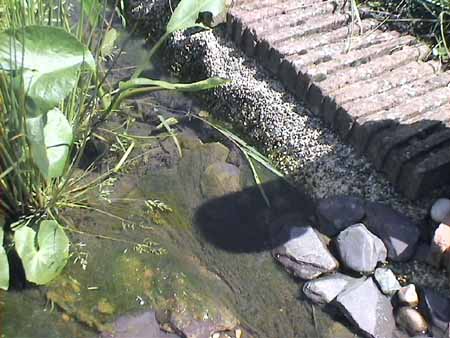
Close-up of the sides where the black liner is covered by the (expensive)
gravel coated plastic.
Now you have double-protection
to a certain degree from the bottom layer getting punctured. Finally, put
a layer of fine gravel on the black bottom liner then also lay rounded pebbles
in the bottom, or large flat stones, slate and anything
else that
helps achieve
a natural look.
Let Nature Do Her Work
The main thing to remember is to enjoy
it and not rush the job. It takes
a good year or two to get a rockery established and the
stream looking good with plants
growing over the edges, etc. As
long as you get the basic shape and size right to start
with, you will continually be
making little adjustments forever after, moving a rock
here or there, selecting the right
plants, and so forth. This is where my wife's
gift of green fingers makes it look lovely. It is definitely
a passion that we now both enjoy
and it gives us something fun to do together.

A year later and the bog area looks great.
Various baubles
and low-voltage garden lights
complete the setting.
The pond looks wonderful at night too with its underwater lights.
More About Overlapping
Note: This section was written before we got a single sheet of pond liner.
Where
the bog area flows into the pond, the normal level of
the pond water would be a couple of inches below the lip
of the bog area.
The PVC liner of the main pond and the liner of the
stream are seperate
pieces, but there is plenty of overlap (see left side of diagram below).
The liner
of the main pond extends up and out to form the whole bog
area as well, and then up the stream a little way (to
prevent capillary action), while the middle pond liner
section forming the waterfall and stream also goes
right down through the whole bog area, and overlaps into
the
pond.
I'm talking
of about 5 or 6 feet of overlap, so that both pieces
of liner form the bog area! This is shown in the following
illustration. Likewise the top pool liner overlaps the
first step of the waterfall section.
Its double-protection. You
have to be sure that this area is able to contain its
water with no leaks.

Again if you can actually
do the complete pond and stream in one piece of liner
that will guarantee no leaks. It depends on the length
you want your stream to be, and also whether you have
already built your pond as to whether you can do it
with one piece.
All I'm saying is you absolutely MUST
get
this right at the start of your project, because you
don't want to be messing about with it later on.
Making the Bog
Also when fashioning the bog area I dug
it deeper than the step which actually leads into the
pond. This was so that we could lay a sufficient depth
of pond-soil for the bog plants to grow in, without the
soil being washed into the pond by the flow of water.
Do NOT use ordinary soil. Get proper pond soil which
is a lot more loamier and heavy and sinks to the bottom
and stays there.
The River Flows Into The Sea
At the threshold of the stream
going into the pond I also have a large flat piece of slate sat atop
of the liner, which the
water
flows
over
before entering the pond. This looks nicer than the
black liner, its also more attractive
than the gravel liner, and more importantly it helps
to prevent soil being washed into the pond. Also the water picks up a little
bit more speed as it flows over the slate before
it enters
the
pond.
One problem we encountered at first and which requires
a bit of messing about with is that the water prefers
to
flow under the slate, rather than over it!
Putting gravel and soil at the bottom edge of the
slate helps
to block it, and over time it silts up with muck
and seals naturally.
Another ponding friend suggested
that
I could have used a can of plastic foam (like the
kind used to fill cavity walls) to create a barrier
underneath
before bedding the stone and this
would have
helped prevent
this problem. If I ever have to uproot and re-lay
this step, then I will most likely do as she suggested.

The large flat piece of slate creates a kind of dam, to prevent soil
and silt being washed into the pond from the bog. Pebbles at the sides
help narrow the entrance into the pond creating a slightly faster flow.
The fish like to push their heads out of the water facing up the stream
to see what morsels of food might be washed out of the marsh to them!
Plenty of Piping
To feed the water from the pump in the
pond, up to the bio-filter and then the top pool, I use
25mm flexible hosing which runs beneath the millstone
edging
of the
stream.
This
means
the pipework
is protected, yet it is simply a matter of lifting the
edging if ever I need to replace it.
When you cut the
pipe to fit your equipment at the top of the stream,
for example to go into flow
control valves or the pre-filter, make sure you leave plenty of extra.
When I first started using the Hozelock
Bio-Force
UVC filter (before I got fed up with it blocking and
requiring cleaning all the time and replaced it with
my own homemade bio-filter), cleaning it required unclipping
and removing the top, but of course because the flexible
pipe was attached to it, this meant the plastic pipe
was constantly being bent back and stressed.
Now you
might think "Isn't that what flexible piping is supposed
to do?". Well yes - but in the winter when the plastic
is
cold, and in time due to the constant bending, one day
the piping cracks and you're suddenly pouring gallons
of
water all
over the place. To fix it you have to cut the pipe back
to a good point, but you can't do that if you've cut
it
too
short in the first place!
So please bear this in mind if you are thinking of using
a filter unit that involves the pipework constantly being
flexed.
Conclusion
Well
that's the stream! We hope this gives you a few ideas,
and would love to hear from you about your project, or
if you have any questions.

Lights placed strategically light up the waterfall at
night.
It's well worth the effort. A stream and bog area attracts
so much wildlife; we get frogs, dragonflies, water-boatmen.
Also its a delight to see wagtails and blackbirds
come to wash in the stream. On some occasions
when heavy
rain
has
raised
the water
level in the pond to overflowing, the smaller fish
will swim up the stream to explore the bog !
The problem with sexy Frogs in the Pond
!
I received an amusing tale from a reader which
went like this:-
"Although my wife and I are keen on native flora
and fauna we have a problem with frogs invading the
fish
pond. Recently it has been cleaned out with netting
secured at the base and also over the top of the
pond. Having
recently restocked the pond she is extremely peeved
that the little blighters are finding a way in. Whether
or
not they are to blame at the moment for the few dead
fish she has found is open to doubt. We do know that
during the mating season the frog will jump almost
anything that moves and fish suffer as a consequence!
Any ideas
about how to keep them out and where can we ship them
with out killing them off?"
My answer: We always have frogs at our pond, but not
necessarily in it. You will see elsewhere in my website
that the
layout is such that we have a top pool and water urn
which feeds
a waterfall, stream and bog area. The frogs frequent
these nice damp places where plants provide cool and
shade without them having to use the pond. Therefore
the upper areas of the pond provide the main habitat
for the frogs.
I can't say that we've ever had a problem with oversexed
frogs "jumping" the fish though! We get frogspawn
in the pond each year, but not much survives because
the fish eat it. Obviously enough do actually make it
though because we always have plenty eager to jump out
at my wife when she's gardening!
Of course frogs help to keep other garden pests like
slugs and insects down, so rather than fighting nature,
work with it by giving your frogs their own damp/wet
area to live in.
This chap has found a home in the rocks
in our stream/bog section:-
Upon closer inspection it turns out there
were 3 frogs chilling out!! 
If you have any comments or suggestions
about this project please contact me:
And if you have found these web pages useful and interesting and would like to
make a donation, you may do so using the Donations
Page.
|




 Top
Top
