 |
DESIGN CONSIDERATIONS
FOR A
DIY BIO-FILTER FOR YOUR POND
Right. I imagine you've just read the introductory
page for this project? In this section I get down
and dirty with some mathematical calculations based upon
advice given at a number of Internet resources during
my research. Don't worry. Skip to the pictures in the
Build Section
if you just want to see how I built it, but you might
find this design section useful to help your understanding
of the processes involved, and what is generally considered
necessary in the design of a biological filter.
Jims
Pond Blog

|
To get the latest news on my
ponding bio-filter and venturi experiments why not
visit Jim's
Pond Blog. You can subscribe to my blog's RSS
Feed powered by Feedburner to ensure you get
the latest updates. It will work with most Atom and
RSS 2.0 compatible news reader software, such as
Bloglines, Desktop Sidebar, NewsGator, MyYahoo, etc. |
This page covers the following topics (click to jump
to them):-
FISHY FORUMS
For great fish-keeping communities visit
my favourite forums at:-
They are very friendly and knowledgeable
groups of people who will make you feel very
welcome. There is tons of discussion going
on about fish of all kinds, problems whether
relating to the health of your fish or the
state of your pond, and advice on filters,
pumps and anything else you can think of!
RELATED SITES
Mike
Bentleys pond page has a very comprehensive
ponding
links page with some excellent homemade
DIY pond bio filter related links showing
a wide ranging variety of ideas and experiments. |
|
I highly recommend Bradshaws Direct (UK) for all your ponding supplies:-
Sick of SPAM? This is what I use every day - It's very good.....

Read my review about Mailwasher Pro Anti Spam Software
Overview
and Design Points
If you're done at the Skippy
site after reading
the previous page,
you now have a pretty good idea of whats involved in
building their
Skippy bio-filter, and how it all works. This picture
is of their basic Skippy
filter "in the raw". Hmmm. I think "functional" is
the word! Well, it's not so bad after a bit of hiding!

A Skippy Bio-Filter |

Where did it go? |
I like the whole idea behind the Skippy design.
However I had some ideas of my own:-
- My pond is not massive (about 400 gallons), so I
didn't think I needed a tank as large (or ugly) as
a "Rubbermaid" used
for the Skippy filter. Please remember that I am not
a professional Koi-keeper! I don't need a massive filtration
system, I just want to improve the water quality
for my small pond.
- Generally a Skippy filter is situated at the top
of, and is effectively part of a waterfall, with its
large
flange outlet (see above picture), the water literally
flows out and down the waterfall (with rubber sheeting
around
the
flange
to prevent water leaking behind any rocks which form
the waterfall). To accomodate this size of tank into
my already built rockery simply
was not practical,
and I wanted
a design with flexible pipe to put the water where
I wanted it - in the back of my terracotta urn.
- I particularly liked their "vortex" design,
where the pipework creates a swirling motion in the
base of the filter, but a "Rubbermaid" is
oblong. Using a cylindrical tank would be better
to maintain a smooth swirl in the bottom.
- I wondered whether I might find something that looks
nicer, and could "blend" into the garden
better.
- Rather than having a drain outlet in the side, I
thought that a drain exiting vertically down out of
the base
would help remove filtered solids more efficiently.
A Rubbermaid tank has a small outlet in the side, near
the base, which is fine for draining just water, but
not great for getting gunky muck out of a bio-filter!
- After reading up on "venturis", I wondered
whether a venturi dedicated to aerating the filter
would improve oxygenation of the aerobic bacteria in
the bio-filter.
|
Well, here is a picture of my
working bio-filter in position (in 2004 before the venturi
was fitted). I find this size is sufficient for my 400
gallon pond.
I suppose a serious koi-keeper might laugh his socks off!
Thats fair enough, and I admit I am a bit eccentric but
I like to try out my own ideas. In time I might paint the
pipework a terracotta colour so its not so garish, and
grow some more plants both inside it (to help filtration),
and around it.
I might also add at this point that by building this filter
myself I did not save money! I think I must have
spent around £100 by the time I had finished experimenting
and getting all the parts together. If I had known exactly
all the parts I needed right from the start it would have
been cheaper, more like £70.
I could have bought an off-the-shelf prefabricated product
of similar size for £50, but I don't think I would have
enjoyed the challenge as much as doing it myself!
|
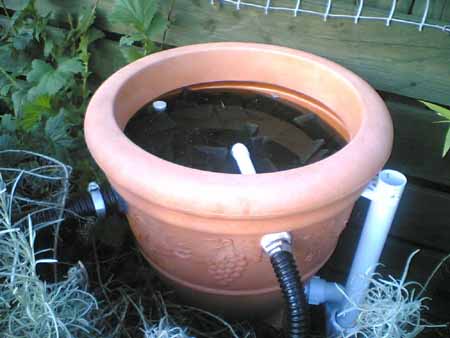
My original 2004 version of a DIY bio-filter |
|
A Quick Recap
Before we continue lets recap on what we're
trying to achieve;
Biological Filtration and the Nitrification
Cycle
A biological filter is quite simply the heart of a koi
pond. It is not essential in small fish ponds, but the
more fish you stock (especially koi), the larger they
get and the more they eat, so the need for a bio-filter
becomes
greater.
The pond gets to a point where it needs a "sewage
farm". It's purpose is to convert the waste matter
produced by the koi from harmful ammonia into less toxic
waste.
It is less important to remove solids particles from water
than it is to process nitrogen, so if there is to be
a compromise between mechanical and biological, err
on the side of biological.
In other words, it is much better
to allow particles below a certain size to escape back
into the pond, while converting a great deal of ammonia
to nitrate, than it is to catch every little thing down
to a micron or less which in the process would slow the
water down to the point where the bacteria have a hard
time
living (because they're not getting enough oxygen).
The
bacteria that convert ammonia to nitrate for us are among
a class of bacteria
that
you may
have
heard
of before.
They are the so-called, “nitrogen fixing” bacteria.
This means that they take nitrogen that is unavailable
to plants in its ammoniacal form, and make it
available to plants in an oxidized form.
These are the same bacteria
that live among the roots of leguminous plants. Without
these beneficial bacteria, life as we know it would cease.
So be kind to your bacteria. What they need to survive
is a large surface area, chemically inert medium and
a ready
supply
of fresh water. They depend upon dissolved oxygen
in the water to live and to do their job. As
soon as the water flow is stopped, the oxygen in the
filter becomes
finite, and eventually gets used up. The ultimate result
is that the bacteria die, and you have to start over.
Also the bio-filter will
benefit from a boost of new fresh bacteria on a regular
basis, say monthly, to replace
any that die-off naturally thus ensuring the process
in the bio-filter continues un-interrupted.
Some people use both mechanical and biological filtration,
and some of the new commercially manufactured filters
available do this. In the first instance, many people
are tempted
to install
a canister filter (pre-filter) ahead of the biological
filter, thinking that they will extend the life of the
media used in the bio-filter
by catching all of the particles that would eventually
clog it up. They are correct, of course, but they wind
up being slaves to the canister filters in an effort
not to destroy their pumps, which have to work too hard
to push water through the pre-filter canister.
It is
better to merely use the bio-filter and to maintain
it well.
Putting
the canister after the bio-filter is a good idea, but
the same problem arises, just less often.
Several types
of bacteria are currently available to you from your
local pond centre stockist, each with its own specialty.
It is important to start out
with
a good supply of beneficial bacteria, especially for
the initial start-up dose, so that you minimize the green
water stage of pond establishment.
There are 2 types of bacterial species that colonise
the biological filter media. Nitrosomonas sp. bacteria which
oxidize ammonia to nitrite,
and Nitrobacter bacteria convert nitrite to nitrate.
Ammonia
Ammonia (NH3) is produced by fish (and particularly
koi because they are fat greedy chaps!), as part of their
normal metabolic function and is excreted from the gills.
The amount of ammonia produced is directly related to
the amount of food they eat. Approximately 3-4% of normal
30-40% protein level koi food will be excreted as ammonia,
i.e. for every 100grams of food 3-4grams (3000-4000mg)
of ammonia is produced.
Koi exposed to unacceptable levels of ammonia risk damage to gills, eyes, fins
and skin which can result in them being susceptible to secondary bacterial
infection.
Using standard drop type tests kits any ammonia reading is considered
unacceptable and remedial action should be taken.
Nitrite
Ammonia is oxidized by the Nitrosomonas sp. bacteria
in the filter to produce nitrite (NO2). Whilst it is
not considered as dangerous as ammonia it can still do
serious damage to your fish. High levels of nitrite are
likely to stress your koi leaving them susceptible to
secondary infection. As with ammonia, target levels should
be that nitrite is undetectable.
Before the fish pond filter can efficiently remove ammonia and nitrite from
the fish pond water, it must first become fully colonized with nitrifying bacteria.
This can take some time and is a process known as fish pond filter "maturation".
Each time a fish is put in the fish pond it will add to the total amount of
ammonia being produced. The ammonia level in the fish pond will therefore increase
slightly. Because there is more ammonia for the bacteria to utilize, they start
to multiply until there are enough to use all of the ammonia being produced
inside the fish pond. The ammonia level in your fish pond will then fall back
to zero.
Nitrate
As the ammonia level falls, the amount of nitrite produced
by the bacteria in the fish pond filter will start to
increase. Therefore, the level of nitrite in the fish
pond will rise. The increasing nitrite level means that
the bacteria that break it down can start to multiply
in the fish pond filter until, as with the ammonia, there
are enough to use up all the nitrite that is being produced.
The nitrite level within the fish pond can then fall
to zero. As this occurs, the nitrate level increases.
Conversion of nitrite to nitrate (NO3) is the final stage of the nitrification
process. There is debate as to the possible problems that elevated levels of
nitrate may cause. Indeed some koi keepers have high Nitrate and it causes
no problem at all. High nitrate may also attribute to green water (phytoplankton)
and blanketweed growth however the two do not always go hand in hand. The
green water problem can get worst when you clean the biofilter and make water
change outs, due to the reduction in bacteria - these are times when you should
add some fresh bacteria to boost the level.
The
bacteria also produces a certain phytoplankton-killing enzyme. As algae
starts to grow in the bio-filter, or on the walls of the pond, the bacteria
loves to feed on this algae, and as it does so it releases the enzyme (like
an antibiotic) into the water. (Fascinating source article can be found here:
http://www.vcnet.com/koi_net/GRENH2O.html).
Green water is a pain for many reasons. Ultra Violet Clarifier lights will
kill single cell phytoplankton algae that cause green water, and when dead
they clump together and can be removed by the filter. However there is sometimes
a concern
expressed
that
passing
water
through the UVC also kills beneficial bacteria. Note that a UVC does not get
rid of blanketweed.
The Skippy site teaches us that we should try to achieve "balance" in
the pond - don't fight mother nature. By use of the bio-filter and other larger
plant forms you starve the water of Nitrate, so that the algae has no food,
and is therefore unable to grow, while at the same time the bacteria create
the enzyme which kills the phytoplankton. Its a double-edged sword in this
battle.
So in summary:-
- Nitrificating bacteria reproduce slowly.
- It can take between 1 and 2 months for a biological
filter to
start
to produce enough bacteria to sustain a pond system.
- To avoid dangerously high levels of toxic waste
levels in a pond, do not add too many fish at one time.
- Do not switch the filter system off for an extended
length of time. Nitrificating bacteria will
die after only a few hours without oxygen,
leaving behind anaerobic bacteria.
- Anaerobic bacteria is toxic to fish and is a common cause
of disease in fish.
- A dirty pond/filtration
system can harbor anaerobic bacteria and
koi diseases such as outbreaks
of parasite infestation and bacterial problems
may occur.
Click here for more information about Bacteria
Cultures and products suitable for Bio-Filters.
|
Some Theory
and Maths
During my research I came across a very complete
and excellent resource by Terry Cusick,Third Alternate
AFKAPS Rep
and Certified AKCA Koi Health Advisor at FishDoc.co.uk to
whom I extend my thanks, and from which a number of extracts
have been used
to compile
this section of my project. I strongly recommend reading
the
complete article since the site provides a very
thorough explanation of the considerations when designing
filtration
systems for ponds to ensure healthy fish.
Essentials
Humans convert ammonia waste from the body into urine,
whereas fish simply excrete it continuously from their
gills
into
the surrounding
water. Normally in a river or the sea it is diluted by
thousands of gallons of water
to render
it harmless.
But nobody told Mother Nature about koi-keepers
and their ponds,
where ammonia can build up to a dangerous level due to
the large number of fish in a small volume of water.
A koi pond has to deal with two types of pollution; solids
waste and dissolved waste from solids. Therefore it
is essential to remove the solid wastes from the water
before
they
have
a chance
to dissolve. If we can do this we gain; better water
quality, fewer dissolved pollutants and ultimately less
fish health problems.
Once the solid wastes have been collected, it
is important that they are flushed out of the system
regularly, before
they get the chance to decompose. In summertime this
could be as often as twice a day. This means that any
settlement chamber incorporated into the filter design
will need to have a drain to allow easy
flushing to waste.
- It doesn't matter whether
the solids decompose in the pond or the filter - the
result is the same
- polluted water!
- To maintain good water quality
it is essential that solids are removed from the
pond and filter before they
have time to pollute the water
- Any trapped solids
must be removed from the system on a regular basis,
otherwise they will simply decompose
and pollute the pond. They will also encourage high
levels of opportunistic bacteria.
For good filtration and water quality very little
solid waste should be allowed to enter the 'biological'
section of the filter. To restate the point made previously;
the more
effective the settlement area of the filter at removing
solid waste,
the lighter the load on the following biological section
- provided, of course, that trapped waste is removed
before it decomposes.
This entails:-
- Regular maintenance to keep the biological
area clean and free of mulm,
- Reducing the level
of dissolved organic compounds by effective settlement/entrapment,
together with regular
cleaning of the settlement area.
- If we can remove solids
from the system before they decompose and at the
same time keep the biological section
of the filter fairly clean we will;
- Encourage a vigorous
growth of nitrifying bacteria
- Reduce the load
on the biological section
Do you see a repeated theme here? Cleanliness is the
order of the day!
Design Considerations
When building a filter it is suggested that
either;
- the filter surface area should be approximately
one tenth that of
the pond;
or,
- that there should be a pond turnover rate of once
every 2 to 3 hours.
How much surface area?
Nearly all types of filtration system rely on "attached-growth" processes
in which a bacterial slime layer or biofilm - comprising
of bacteria, algae and often-larger invertebrates,
such as worms and snails - forms on the media. Micro-organisms
present in the biofilm 'feed' from the water as it
flows past. So, as a first approximation, the amount
of biological activity will be determined by the amount
of available surface area for bacterial
colonization. However, in practice this available specific
surface area (SSA), as
it's called, is rarely a limiting factor since most
filtration systems are large.
Bacteria will thrive on almost any surface and the particular choice of medium
has very little influence on their growth.
Obviously, if you had just a square piece of material measuring say 1m x 1m this
would give a total area of 2 square meters (because both sides are available
for bacterial colonization assuming almost zero thickness). Even this small area
could support millions of micro-organisms, attached in a slimy biofilm. But typical
filter media have a far greater SSA.
For instance, gravel has an available surface area of about 100 to 200 square
meters per cubic meter (100-200 m2/m3). This area is also often expressed as
the Surface Area to Volume Ratio, for example 200:1.
And other, more specialist media can have significantly more surface area as
indicated in the table to the right.
So you can see that even a small amount of filter medium provides a potentially
vast SSA for bacterial colonization.
Each square meter of biologically active
surface can metabolize nearly one gram of ammonia per day, dependent on temperature,
and given that most ponds will usually be producing fewer than 60g of ammonia
per day, the amount of SSA required is really small - and "not a lot of people
know that", as Michael Caine might say!
If we based filter sizing on the basis
of SSA alone, filters could be incredibly small -perhaps only the size of a
shoe box! However, there are other factors to consider....
|
| Media |
SA to V Ratio |
| Flocor |
200:1 |
| Stone(2cm) |
70:1 |
| Kaldnes K1 |
800:1 |
| Bio Block |
700:1 |
| Bio Balls |
550:1 |
Bio bale
from CPRAquatic |
800:1 |
| Hozelock Cyprio Media |
180:1 |
| Scouring Pads |
300:1 |
| Siporax |
10,000:1 |
| Ceramic |
1,000:1 |
| Fine Foam |
1,000:1 |
| Coarse Foam |
200:1 |
| Medium Foam |
600:1 |
| Trickle Media |
200:1 |
| Bio rings (5/8in.) |
340:1 |
| Bio rings (1in.) |
210:1 |
| Bio rings (1.5in.) |
130:1 |
| Compac 3 |
280:1 |
| Hair Rollers |
150:1 |
|
Is void Important?
The void size or empty space within a filter medium
is important in determining the right filter size and
efficiency. Void size is a measure of how much of the
medium consists of empty space. If we consider sand,
for instance, each particle has a large surface area
in relation to its volume and the total SSA per cubic
meter of sand works out at thousands of square meters.
Despite this enormous SSA, sand would make a poor filter
medium because the small particle size would soon lead
to blockages and subsequent 'tracking' as water found
the 'easy routes' round the medium. And, of course, because
of the dense packing, any flow through the sand would
be very slow. So, despite its massive surface area, once
compacted and blocked the amount of surface area exposed
and the volume of water that could be treated per hour
would actually be quite small.
There is another important disadvantage of a medium
like sand - retention time, or the
amount of time the water spends in contact with the biofilm. It is obvious
that if we wish to avoid blockages and tracking, some
void space in the filter medium or media is desirable.
If we consider a medium such as gravel, although its
larger size yields less SSA it is less prone to tracking
and blocking. And specialist media such as filter matting,
plastic or sintered glass have both a large SSA and a
generous void space. In fact, many of them are more than
90% void or empty space! This makes tracking and blockage
almost impossible.
What about cleaning? Another important consideration - which becomes more
important the longer you keep koi! - Is ease of cleaning.
In the early days of the hobby, part of the novelty lies
in spending weekends cleaning and vacuuming. But after
a while, strangely, it seems that there are more pleasurable
ways to spend a sunny Sunday. And with gravel and other
granular media, it really isn't much fun trying to clean
several tons of the stuff! Compared to gravel, cleaning
lightweight media is a delight. Obviously, regular maintenance
is somewhat easier if each filter chamber has its own
bottom drain but, even so, ease of maintenance has to
be a major consideration in the choice of filter medium.
The three major factors affecting our choice of filter
media are:
- Specific surface area
- Void space
- Cleanability
Bio-Filter Water Retention Time
Broadly speaking, the effectiveness of biological filtration
is improved the longer the 'polluted' water is held in
the filter - i.e. the longer the retention time.
The most time-consuming process in filtration is the
breakdown
of dissolved organic carbon compounds into simple inorganic
compounds. These compounds are ultimately incorporated
back into living organisms. This complex chain of processes
is not instantaneous and will, even under ideal circumstances,
take some time. If insufficient filtration time is available,
intermediate products will be pumped out of the filter
back into the pond. This is clearly undesirable and rather
defeats the object of having a filtration system. Indeed,
this may well be the reason why excessive alga growth
occurs in some ponds, with the filter merely producing
an endless supply of plant nutrients!
So for how long should
water be retained in the biological section?
This depends
on how polluted the water is in
the first place. Certainly, industrial water treatment
plants - which handle much higher levels of pollution
from sewage etc. - would retain water in the plant for
many hours before it was deemed sufficiently clean to
return to the nearest water-course.
Given that pond water
is likely to be only mildly polluted, a retention
time of 10 minutes, possibly longer, will usually suffice.
The
more polluted the water is, the longer it needs to be
retained in the filter. Most koi ponds will require a
retention time of at least a few minutes.
How do you calculate
the retention time of your filter? Doing the Maths
This is determined
by the flow rate and the volume
of water in the filter. If water output from the filter
is 2,000 gallons/hour and the filter contains 500 gallons
(when full of media) of water then:
filter retention time = filter size / pump rate
so, in our example:
retention time =
500 (gallons) / 2000 (gallons per hour flow rate) = 0.25 hours (which is 15
minutes).
So
a given sample of water will take 15 minutes to pass
through the filter and back to the pond.
In the above,
the filter capacity represents the amount of water in the filter - not the
physical size of the
filter, which will be greater.
The retention
time and
the size of the filter will depend to
a very large extent on the type of filtration medium
used.
A solid medium
with low void space such as gravel will occupy much more
filter space than large-pored, lightly packed media and
therefore leads to a lower retention time.
More calculations!
Using our same example of a 500-gallon
filter. If we now nearly fill it with gravel, the
volume of water it will hold will be reduced substantially -
maybe to as little as 150 to 200 gallons. Using the above
example, the retention time of such a filter would
now become;
200/2000 = 0.1 hours (6 minutes) or less
In comparison, if the
same filter was filled instead with matting or plastic,
there would be hardly any displacement
and the filter will probably still hold in excess of
450 gallons, giving a retention time over double that
of gravel. So a filter with a dense, low-void medium,
such as gravel, will need to be substantially larger
than one based on light-weight media, in order to achieve
the same retention time, which explains why koi filters
were traditionally so large.
Turnover - The quicker
the better?
Just when everything starts to make
sense, along comes a complication. While a longer filter
retention time
will produce better water quality we also have to consider
pond turnover times. Why? Because
polluted water is produced in the pond and, if there
was a slow turnover at the
filter, it would take longer for pond water to get processed
by the filter.
To make sense of pond turnover rates it
is helpful to return to the original analogy of koi being
sewage-making
machines: expensive food in one end and sewage out the
other. Our seemingly impossible aim should be to remove
this pollution as fast as it is produced. If we can manage
that then we would have perfect water conditions most
of the time.
When we are considering pollution the primary
concern is not so much the volume of water, but rather
the number
of fish and the amount of food we feed to them -
because this is what determines both the amount of metabolic
ammonia
and the quantity and quality of solid waste. There are
several ways to calculate ammonia production in a koi
pond. A rough and ready estimate can be made based on
the amount of food fed each day.
How
much Ammonia from that much Food?
Each kilogram (2.2 pounds)
of fish food will result, on average, in 37 grams of
ammonia being produced, together
with copious feces. And there is other organic waste,
such as that from decomposing algae and microorganisms.
The important point is that as the stocking, and thereby
feeding level, is increased the water will have to be
treated at an ever quicker rate if water quality is to
be maintained. If, for instance, we had a pond of 4,500 gallons and
the fish were fed 200 grams (7 ounces) of food per day,
this would produce approximately 7.5 grams (7,500mg)
of ammonia per day, an average of say 300 mg per hour.
(In reality the ammonia level would fluctuate throughout
the day, being highest shortly after feeding).
1kg food = 37g
ammonia
1000g / 200g fed = 5
37 / 5 = 7.4g = 7400mg / 24hrs = 308mg per hour.
At this feeding rate, if no ammonia was removed,
at the end of a day the ammonia content of the water would
be 24hrs x 300 mg ammonia = 7,200 mg in 4,500 gallons
of pond water, giving an ammonia concentration of 1.6 mg/gallon or 0.37 mg/litre,
which is too high.
Conversely, if it was possible to remove the ammonia at
the same rate as it is produced - namely, 300 mg per hour
- the steady state ammonia level would
be zero. Assuming we have a perfectly sized filter, then to
remove ammonia this quickly we would have to pass the entire contents of the
pond
through
the filter
every
hour,
giving
a flow-rate
of 4,500 gallons/hour,
otherwise there will always be some residual ammonia present.
Deep breath!
If, instead of a flow-rate of 4,500 gallons/hour, we had a flow
rate of the pond volume every two hours - or half the pond volume every hour
(same thing), an oversimplified calculation would give:
300 mg ammonia / 4,500
gallons (pond volume) x 2,250 (flow rate gallons/hour) = 150 mg ammonia removed
per
hour, leaving 150mg in the pond, or a steady state
of >0.01 mg / litre. (This makes the simplifying assumption that there is
no nitrification occurring in the pond.)
What is an Adequate Flow-rate?
So what is an adequate flowrate?
As explained, it depends on the feeding rate.
The most commonly quoted
advice is: turn over
the volume of the pond between 8 and 12 times a day. Otherwise expressed as between one-third
and one-half every hour.
Filter Size
Click
here for a great resource for calculating and converting
Volume.
Taking retention times and flow rates into consideration,
when it comes to choosing the right filter size, there
are two important but conflicting factors:
- the right filter retention time, which ensures all
the required biological activity occurs,
- brisk water
flow to prevent a high pond ammonia level.
If
we decide that a flow-rate of say 2,250 gallons per hour
and a filter retention time of 10 minutes are
required then the volume of water in contact with the
filter media at any time will need to be;
2,250 gal / 60
(minutes) x 10 (minutes retention time) = 375 gallons
or 50ft3
This means that the filter should be able to hold 50
cubic feet of water after it is filled with media. This
is in addition to settlement and spaces below the media
trays. The required size of filter will then depend on
the media used. Using a high-void medium, such as matting
or plastic, we would need a little over 50 ft.3 of media
to compensate for the small amount of water displacement,
whereas, with a solid medium, we might need at least
double the size to ensure the same volume of water in
contact with the media after displacement.
Let the Water Flow When initially designing the filter you have to apply
some theory, as was just done in the previous sections.
While the quoted factors provide a guide, you cannot
be quite sure how accurately the pump really performs
as compared
to
its intended
statistics
due to a variety of factors;
- pump rating,
- head of water it has to push from pond to filter,
top outlet, or water feature,
- natural flow resistance in the piping and the pre-filter
and bio-filter, UVC unit, etc.
- increased resistance over time due to solids building
up if using a pressurised filter unit
After you have built your filter system, its simply
a matter of timing how long it takes for the water to
flow when filled up from empty.
For this experiment you should consider what constitutes the filter, and from
which points to time it. For example the main priority is the bio-filter itself.
Turn off the pump, then empty the bio-filter section by whatever means (drains,
valves, unclip piping, etc), do them up again, and then turn on and time it.
In my case I consider the complete system to be from the inlet of my pre-filter,
then into the bio-filter, and then on into the terracotta urn at the top of
the waterfall because I also have some filter media in there
too. So while my actual bio-filter unit is quite small, and the theoretical
retention time calculated may at first sight seem too small to allow sufficient
bacterial activity (the water goes through too fast), when the 'big picture'
is taken into account and the effects of the pre-filter and urn are also considered,
and you time it for real, then the calculated
retention time can be extended by a certain factor. What do I mean by this?
Well when the water finally pours out of the urn, do you think the filtering
stops there? No, of course not! As I have a waterfall, with plenty of algae
formed on it, followed by a stream, then a bog area with various plants, then
I can probably include these in the retention time as well because they will
also have a residual beneficial action.
So I could consider the retention time to be from when I first turn the pump
on, until the water starts to flow back into my pond at the end of the stream.
Even then there will be natural bacterial activity on the pond walls. Another
addition is that even though we have just timed the direct water flow effectively
from point A to point B, there will be eddies and slower points where some
of the water is held back
by the
filter media, plants and so forth. So the real retention time is likely to
be greater than the mathematical model.
In larger filtration systems the maths is likely to be more accurate, but we
know that even in small garden ponds with few fish, and without filtration
that the water can be nice and clear just on the basis of balanced
natural processes.
| 
Summing
Up
Ideally, what we want is a fairly brisk flow-rate,
turning over the pond volume every 1 to 3 hours
(depending on feeding and stocking rate) but at
the same time a slow, almost imperceptible flow
through the filter, allowing sufficient time for
the various important biological processes to occur.
Water passing through the filter should be in contact
with the filter media, and therefore the biofilm,
for at least ten minutes, possible longer.
There are enormous benefits to be gained by a
fast turnover rate. More air/oxygen will be dissolved
into the water. The solids suspended in the water
will be removed more quickly resulting in a clear
pond, and the fish impurities (ammonia) that are
dissolved in the water will also be removed faster.
Your fish will be more happy and healthy. Your
water will sparkle. The colours on your fish will,
generally speaking, be better.
As you increase the turnover rate the ambient level of ammonia decreases and
at around a full pond turnover rate every two hours through the filter, or
filters, the ammonia levels should be below what can be registered on a test
kit.
As a rule of thumb a flow rate of between 60 - 80 litres (15 - 21 gallons)
every minute per square meter (10 square feet) of chamber surface area will
slow the water down sufficiently to give 100% conversion of ammonia in a single
pass through the filter chamber but still maintain the high pond turn over
rate you are trying to achieve. A slow flow rate such as this will also encourage
settlement of solids.
As a working example: Pond volume about 5000 gallons. Pump needed to turn the
water over in under two hours = about 44 gallons per minute flow rate (unrestricted).
Filter chamber surface area to cope with a flow rate of 44 gallons per minute
= about 22 - 29 sq. ft. (15 - 21 gallons per minute per 10 square ft).
You don't have to rip out your existing filter if it does not fall within these
parameters - if your fish are alive and well and growing you are doing something
right. You can also make some clever 'adjustments' or minor modifications to
your existing filters to achieve these parameters.
So for example if you're building a 3000 gallon pond, you will need a main
filter pump capable of delivering at the very least 1000 gallons per hour (3000
divided by 3). However, pump ratings are all given at zero head, the height
between the pond surface and the point that water is returned to the pond.
The more the head, the less the flow rate, as more power is required to push
the water 'up hill'. All pump manufacturers calculate the maximum recommended
head for their pumps and provide a chart giving the final flow rate at a certain
height of head pressure.
|
Sunshine Another consideration when calculating the volume of water that a bio-filter
must manage is as follows:-
Add 25% to your basic volume if your pond is in full sunshine - because
the water will warm up quicker, and algae
will grow faster.
Add another 25% if your pond is less
than 75cm (2' 6")
deep - because a high percentage of the water in the
pond is exposed to the full power of the sun and algae
will grow faster. Then add between 15-35% to
your pond depending on where you live, if the pond
is in the UK, it is
going to be cooler and less sunny than if the pond
is located in a country near the equator. If it is
hotter and sunnier then algae and fish will grow faster.
This
then gives us an effective pond volume, which is the
amount of water we need to filter. Again the entire
effective volume of the pond has to pass through it
approximately
once every
two hours.
Lets say the pond is in full sun, in South Africa.
It is 0.9m x 0.9m x 0.9m (3' x 3' x 3') so would have
an actual pond volume of approx. 730 litres (160 gallons).
In this example we would add 25% for the pond being
in
full sunshine and 35% for the lovely African climate
giving a total addition of 60%. Therefore, we must
filter the ponds effective volume (730 x 60%=1168)
of 1168 litres (257 gallons), and any pump used should
have
a flow
rate
of at least 584 litres per hour (128 gallons per hour).
So
we would filter the pond as though it had 1168 litres
of water in it, and any pump we use should have
a flow rate of 584 litres per hour.
If you can cut down the sunshine falling on your pond
then this can greatly help reduce algae and blanket
weed growth. Keeping sunshine off the pond will keep
the water cooler, so slowing down their growth, and
also providing healthier water for the fish. Have a
look at my page on How
to build a Pond Cover to protect from Herons and cut
out Sunlight. It might give you
an idea for something you could make that would be
suitable for your pond.
|
My Calculations
Although my needs are very small-scale,
perhaps even not worth worrying about from the point
of view of ammonia production, I thought it would be
an interesting lesson to perform the calculations for
my
setup.
First of all I need to estimate the amount of ammonia
my fish produce in a day. This is likely to be quite low
because I have a small pond, with only 14 small to medium
fish (largest ghost koi is about 12 inches).
Feeding the Fishes
I use Tetrapond Floating Food Pellets in a 1150g tub.
I wasn't sure what weight of food I was giving them each
day. I only thought of it as a couple of medium size
handfuls in the morning and again in the evening, possibly
a little more at weekends when the grand-children like
to see and feed them. So to get an accurate idea I got
the tub of food, some weighing scales and found that
it took 7 full handfuls (as much as I could grab) to
give 100g of food. This equates roughly to 14g per handful,
maybe 10g for a small fistful, more like what I actually
pick up when feeding them.
So I feed them about 4 medium handfuls per day, which
equates to between 40g and 60g per day. This is nothing
like the figures we were using earlier on this page,
which at 200g were probably more the norm for real koi-keepers.
In fact when I measured out just 100g of the pellets
I was surprised at what a large bowlful it was. As an
aside if I feed an average of 50g each day, the tub at
1150g therefore should last me 23 days. In fact the tub
lasts much longer than this (more like 2 months), and
I think its because I
am more of a sucker when feeding the fish, than when
my wife feeds them!
Now lets calculate the daily ammonia:-
1kg food results in about 37g ammonia excreted by the
fish
1000g / 60g maximum fed each day = 16.6
37g / 16.6 = 2.228g = 2228mg / 24hrs = approx. 93mg per
hour.
As stated earlier each square meter of biologically active
surface can metabolize nearly one gram of ammonia per day.
My fish produce > 2g each day (2228mg). Lets say 3g
to be safe because they probably forage and eat other food
in
the
pond, although
it will be of very low protein content. So I need an SSA
of at least 3 square metres. I'm using scouring pads as
the media with a ratio of 300:1, or 300m2 for each cube
metre
of
media. Imagine a box 1m x 1m x 1m, its quite
big. But now imagine a big flat square 300m long and wide
(think 3 football pitches long on each side), now mentally
fold up that area and pack it into that
box. Thats quite a remarkable area to fit into the box!
So 1 cubed metre / 300 = 0.0033m3 (or 3300cm3). That is
3300cm3 required per m2 per gram of ammonia. We reckoned
on 3g ammonia, 3 x 0.0033m3 = 0.01m3 (10,000cm3) of filter
media. The square root
of
10,000cm
= 21.544cm,
so
roughly a 22cm length x 22cm width x 22cm height cube would
be a sufficient amount of media to handle
the ammonia. Scouring pads don't come as one big lump though,
so they would actually need a slightly larger
container!
Turnover
My pond contains about 400 gallons, and my pump is rated
at 616gallons/hour at 1m head, although its maximum flow
rate is quoted as 4000litres/hour (880gallons/hour).
I will add 25% for the pond being in full sunlight, and
15% because I am in the UK, so giving 40% and resulting
in 560 gallons effective volume. Therefore I need a flow
rate of only 280 gallons per hour (half the pond volume),
or about 4.6 gallons per minute for recommended pond
volume turnover.
My waterfall is at about 1m above pond surface level,
so
in fact my pump at 616gph / 560
=
1.1.
So every hour the whole pond water
would be recycled one and a bit times, or about 21
times in a day. Thats a very fast turnover considering
the
recommended is 8-12 times a day. In fact it will be
less than that because my Cascade pump
also
has
a
bell-effect
water fountain, so some of the water just cycles in
the immediate vicinity of the pump within the pond rather
than going to the filters. Perhaps I can use
my
fountain to help reduce the power and flow of water
that is directed to the filters so as to increase the
retention time in the filter, but I have a feeling that
my stream would then be little more
than
a trickle. Catch 22!
Retention Time
Hmmm. I have a feeling this is going to be ridiculously
small. Suppose the bio-filter were based on a 22cm cube
(the figure calculated for SSA earlier for the ammonia
was 10,000cm3). This would hold about 2 gallons of water.
But the pump
at
616gph would push the water through in about 12 seconds!!
Thats a far cry from recommended RT of 10 minutes. Even
if I reduced the pump flow to my desired 280gph, that
still only gives a 25 second RT.
So lets work it out the other way, to figure what
size the bio-filter should be to obtain 10 mins
RT:-
280 gal flow-rate / 60 (minutes) x 10 (minutes
retention time) = 46 gallons or 7ft3 (about a 59x59x59cm
cube).
What does this mean? We seem to have a contradiction in
that the amount of ammonia my fish produce suggests I
need a filter capable of holding only 2
gallons, and
yet to hold the water for 10 minutes, I need to increase
its size to 46 gallons!
When I looked at the size of commercially
produced bio-filter units rated for my size of pond I
thought that as long as I build something of similar
size I can't
go too far wrong. What surprises me however is that the
theoretical calculations as described on this page, when
applied to the dimensions of such commercial filter units,
indicate that the small-scale units are far
too small
to achieve anything near a 10 minute retention time!
Also when you consider that these units usually have
half their volume as pre-filter, and the other half as
bio-filter, and often using a plastic filter media with
a lower SSA ratio of say 180:1, then I am skeptical of
them achieving any benefical biological filtration because
the water passes through far too quicky.
Surely they can't be too far wrong though? I can surmise
in my situation that ultimately the filters main function
is going to be creating clear water, rather than reducing
ammonia.
The Real Thing
When it comes to the actual practicalities, and the
size of container (big flower pot) I have chosen it actually
works out more like this:
The pot is a cylinder of average diameter 38cm (it narrows
slightly from top to bottom, so I take the measurement
at the middle). It has a filter media depth of about
32cm (the pot is actually taller/deeper but the media
itself is 32cm deep). To calculate the volume we use
Pi x radius x radius x depth,
or 3.1415927
x 19
x 19
x
32
=
36291cm3
= 8gallons.
A
flow rate of 616gph would have a retention time of 46
seconds, and if reduced to 280gph would be 1 min and
42 seconds.
As mentioned earlier, after building the filter
system, time how long it takes
for the water to
flow when filled up from empty.
I did a test and timed my completed system: pre-filter,
bio-filter, water-feature urn, waterfall and stream.
It takes 4 and a half minutes before the water spills
back into the pond again, which is nearer the goal of 10
minutes retention time, and I believe is probably adequate
for a pond of my size.
|
Next stage is to build it!
Click here
for the next page. If
you have any comments or suggestions about this project
please contact me:
And if you have found these web pages useful and interesting and would like to
make a donation, you may do so using the Donations
Page.
|
|


 Top
Top

