 |
How to Construct a Homemade
DIY Pre-Filter
|
This page shows you how I made my own design of pre-filter to use with my "Skippy"-style bio-filter. Below you can
see two photos showing the bio-filter before and after
fitting my pre-filter.

Before |

After - Yes, that white pipe contraption! |
Ok, it looks a little odd, but
it works well for me. The pond pump pushes water from
the pond via a control valve (which lets me adjust the
pressure going into the filters), into the bottom of
the pre-filter, up through some filter media, then out
via a T-junction
side-ways into the bio-filter. I have had it in use for
several months, and it definitely helps
keep
larger
muck
from
entering
the
bio-filter.
However it may not be suitable for everyone - I will
say why in a moment.
First I will explain why I created this design.
- First some history - In some
of the other pages on this website I explain how
I got fed up with my Hozelock Bio-Force UVC filter
because
it was too small for my pond (green water was a problem),
the coarse/fine foam filters would block up frequently
and it was a
right
back-breaking,
fiddly,
pain in the butt to clean regularly.
So
I decided
to build my own design of Skippy filter as the main
filter but for a while continued using the Bio-Force
to pre-filter the water before the bio-filter - until
I got totally fed up with cleaning it so stopped altogether.
So for a while my Skippy bio-filter had NO pre-filter to keep muck out of it!
- After a little education from the original Skippy
Bio-Filter web site I changed my attitude on pond maintenance
from trying to do as little and infrequently as possible,
to making sure I was cleaning things regularly - because
that means happy healthy fish. But to
encourage
yourself to perform regular cleaning means you want
to make things as quick and easy to clean as
possible.
- The Skippy web site told me that having a pre-filter before
my bio-filter would help its long-term performance,
because there is less muck going into it, which means
less fish solids decaying in the bio-filter
(solids require anaerobic bacteria
to dissolve/eat it up - not
the kind we want), and so by filtering out the solid
muck, it makes life easier for the aerobic bacteria
to develop which
are the
good kind
of bacteria
that turn poisonous ammonia (excreted by fish), into
nitrites, and then convert nitrites into harmless nitrates
which plants can eat up.
- Have you ever been on a boat holiday?
A motor cruiser on the Norfolk Broads or the Thames?
If so you might remember one of the daily maintenance
tasks is to clean the
water
filter
for
the boats engine,
which
pumps
cold water from the river to keep the engine cool.
The filter prevents river weeds from being drawn into
the engine cooling system, but each morning before
you start the engine you have to unscrew the top of
the filter, remove the metal gauze and clean it, then
pop the gauze back in and screw the top back on. Well
this is the kind of thing I had in mind for my design,
except of course using PVC piping and fittings rather
than metal which might contaminate the water.
Advantages:
- Solves the problem of not having an out-of-pond pre-filter
before a Skippy style bio-filter. DIY'ers who
build their own bio-filter often tend not to have
any kind of pre-filtration, and this ends up with
the Skippy
becoming gunked up and less efficient over time. Some
people rely on a pre-filter cage over their pond-pump,
but this can require regular removal of the pump from
the pond for cleaning. I prefer to have a low-maintenance
solids-handling pump and deal with the first stage
of filtration out of the pond in my easy-clean pre-filter.
- Fairly easy to construct using basic tools
- Because it has a only small surface area in which
to trap weed and sediment, it can clog
up fairly quickly but this
doesn't matter because cleaning it is dead easy!
Even so it doesn't clog up quite so easily as foam
does.
- Uses the same type of green scrubbies (nylon pot
scouring pads) for filtration as I bought to use for
the bio-filter
media
- Is at a nice height to maintain - no more bending
over fiddling with Bio-Force clips, big o-rings, foam
and bending flexible pipe until eventually it breaks
(you'll know what I mean if you've read my other pages).
- Is quick to unscrew the top, remove the filter, rinse
with water, re-insert and screw the top back on again.
This is a 2 minute job, and 1 minute of that is a leisurely
stroll from the pond into my utility room to clean
the filter mechanism under a running tap. So I really
don't mind if
I have to clean it daily in the summer, although
that is my own preference - it will last for a couple
of days without cleaning. In winter it only needs cleaning
once every 4 to 6
days.
- Works with my existing design of bio-filter
- Bacteria solution can be poured into the top of the
pre-filter and "injected" right into the heart of the
bio-filter to boost bacteria levels after cleaning
or topping up the pond.
Disadvantages:
The pump I use nowadays is fairly powerful. I have a
Hozelock Titan 8000 litres/hour solids-handling
pump. This is a beast of a pump which I throttle down
using a control
valve. In fact I have two valves near the top of my waterfall.

The 25mm flexible hose from the pump leads into a T-piece (top-left).
The T then
leads one direction into a valve (bottom
of photo, its closed in this shot) which controls the
rate of flow into the pre-filter, then
bio-filter, then exits
to the
top of the waterfall.
The other side of the T leads into
a second valve (top of photo, about
half open in this shot) which acts as a bypass straight
to the waterfall.
This means I can use the valves to balance the flow
either to the filters or the bypass. I adjust the
flow so its correct into the bio-filter (fast enough
to operate the
venturi
to
mix air into the water as it enters the bio-filter,
but slow enough for the bacteria to do their work),
while excess flow can go to the
waterfall
to give the stream a nice convincing flow.
I tell you - with this pump and the valves I have all
the power I need to operate things efficiently for my
pond. I really really wish I had bought this pump in
the first place. But I learnt the hard way and went through
2 lesser pumps initially (but they are not wasted because
I use them for other purposes now). If I turn both valves
fully open the flow down the waterfall and stream is
enough to wash away gravel and small pebbles!!!
Anyway - back to the point in question - the possible
disadvantages.....
My pre-filter design
might not work so well with a pump less powerful than
say 2000 litres/hour because as the filter catches
the muck it will block and restrict the flow of water. Something
less powerful may not be able to overcome the uphill
height, and push through the pre-filter.
Actually I have found that the green scouring pads in
the pre-filter
are great for trapping large particles of weed, fish
crap and uneaten food, but actually do not restrict
the flow of water too much. Well, certainly not as
quickly as foam/sponge does. Smaller particles pass through
and are caught by the vortex settlement
chamber of my bio-filter design.
Remember that with this design I am happy to clean the
pre-filter on average once every day or
two, and far less frequently in the winter - but its
so easy its hardly a disadvantage! The only thing
that might make
it awkward to clean frequently is if the layout
of your pond and garden makes it difficult to get at
the pre-filter. But only you can be the judge of that.
And the layout of your pond equipment for easy maintenance
should be a strong consideration right from the start
anyway.
If someone
tries building my pre-filter and uses it successfully
with a smaller pump I would love to hear from you. I'm
not saying
it
won't
work - just bear it in mind before you go buying the
parts to make this pre-filter! I think I spent about £23
on the various parts.
So if this sounds useful to you, read on to learn
how I constructed it.......
then adapt the design to your own needs.
Jims
Pond Blog

|
To get the latest news on my
ponding bio-filter and venturi experiments why not
visit Jim's
Pond Blog. You can subscribe to my blog's RSS
Feed powered by Feedburner to ensure you get
the latest updates. It will work with most Atom and
RSS 2.0 compatible news reader software, such as
Bloglines, Desktop Sidebar, NewsGator, MyYahoo, etc. |
FISHY FORUMS
For great fish-keeping communities visit
my favourite forums at:-
They are very friendly and knowledgeable
groups of people who will make you feel very
welcome. There is tons of discussion going on
about fish of all kinds, problems whether relating
to the health of your fish or the state of
your pond, and advice on filters, pumps and
anything else you can think of!
|
|
|
|
Building the Pre-Filter
Here you can see a side view of the pre-filter assembly
which shows clearly the use of a self-cutting
outlet kit (the grey bit) which directs the water
into the bio-filter.
The topmost section is a 40mm pipe Universal connector
which provides the screw-top and access-plug which
you undo to remove the filter-pads for cleaning.
Right at the bottom (not visible, see further down
this page) is a 90 degree bend which the flexible
hose from the
pump
connects
onto.
The water
passes upwards from the bottom, through the vertical
pipe body of the pre-filter, passing through the
filter-pads which are held in place internally by
a metal rod
and plastic spacers, and then out through the outlet
kit, which feeds via a 22mm diameter straight overflow
tank connector into the side of the bio-filter.
|
 Side view of my pre-filter
 |

The main parts used in the construction.
- 1 x Self Cutting Outlet Kit - adaptable to 32mm
or 40mm diameter piping
- Length of 40mm diameter plastic piping 1 metre
should be sufficient, but its usually sold in 2.1m
lengths,
the actual length depends on how much clearance
your pre-filter has from the top of the bio-filter
down to ground level. My bio-filter sits upon a
couple of house bricks, which are on top of a paving-slab
platform, providing a good solid base which raises
it above ground level by a foot or so.
- 1 x 40mm diameter Universal Connector (comes
with set of rubber and plastic sealing rings)
- 1 x 40mm to 32mm diameter Reducer (comes with
set of rubber and plastic sealing rings)
- 1 x 22mm diameter Overflow Straight Tank Connector
- 1 x 22mm diameter Overflow Bent Tank Connector
- 1 x 40mm diameter Push-fit Access Plug
- Set of 40mm diameter Waste Pipe Clips (shown
in photo, but were not actually used)
The most expensive part was the Self-Cutting
Outlet Kit at about £8. You can see that
I got all these parts from the local Focus DIY
store (in
the UK). I expect other countries will be able to
supply same or similar types of fittings.
Before we go any further, its time
to familiarise you with the internal workings of
the pre-filter, so that you'll understand how it
all fits together, and where each part is used. So
here is an exploded view of all the parts. Don't
worry, it only looks complicated because of all the
extra washers and o-rings. 
Now each piece in turn:-
|
Self Cutting Outlet Kit
This is the most complex and expensive part. Normally
this is used to allow easy plumbing in of the
waste water outlet flexible hose from a washing machine
into
a sinks
drain pipe. It also prevents
back-flow of dirty water from the sink into the washing
machine by means of a non-return valve.
The clamp holds onto the 40mm piping by means of
4 screws and a rubber sealing pad. Once its position
has been measured and it is clamped into place, you
use a special cutting tool (the black bit at the
top of the bag, this is supplied complete with the
kit). This is used to cut neatly through
the wall
of the
pipe. Don't cut until you know exactly where you
want it positioned on the pipe.
Also included in the kit are a variety of connectors
and bends, and a special non-return valve.
Not all of these parts were required for the
pre-filter assembly and so a couple were just put
in my spare parts box
for some future purpose! |
 |
Universal Connector
The Universal Connector fits onto the top of
the main pipe, and uses the rubber seals and
plastic o-rings to make a good watertight seal.
The bottom screw section is screwed very tightly
onto the main pipe so it never comes undone,
while the top section is used to screw on the
Access Plug. This is done up only moderately
tightly because it is this screw top and plug
that you will undo and remove every time you
need to clean the filter.
|
 |
Access Plug
The Access Plug is simply a blank-plug used
to block off 40mm piping. You should find one
of the O-rings supplied with the Universal Connector
will fit over the Access Plug.
As mentioned above it is the bit you remove each
time you need to clean the pre-filter.
Below it is shown the.........
OverFlow Straight Tank Connector
Originally my bio-filter had a different connector
in the side (see pic below), but that particular
fitting would not have connected to the Self
Cutting
Outlet
Kit.

Old connector - no good
So
I replaced it with this new 22mm Straight Tank
Connector (pic at above right)
Note: When installed in the
bio-filter the left hand side of the connector
as shown in this photo was facing outward,
and the right hand side was inside the bio-filter.
The 22mm pipework inside the bio-filter (which
leads into my homemade venturi unit), simply
push fits into this connector - the screw-up
cap was not necessary.  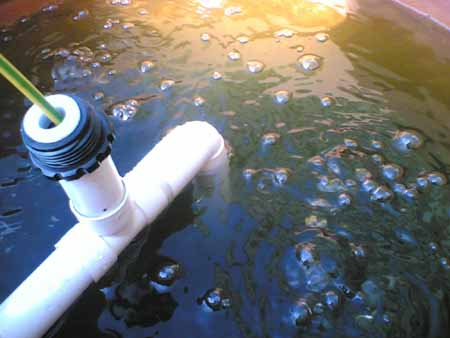
These are just example pics showing the
pipe push-fitted into the connector (left),
and my venturi (right).
|

Straight Tank Connector - LH Side outside, RH Side
inside bio-filter tank
In the top-half of this photo you can see how
the 40mm Universal Connector, Access-Plug and sealing
rings fit together at the top of the pre-filter
pipe. (Ignore the bottom half of this photo for
the moment, I'll explain it later).
|
| |
|
Universal Reducer
The Universal Reducer is normally used to change
from a 40mm section of pipe down to a 32mm section
of pipe.
This Reducer attaches onto the bottom of the
main pre-filter 40mm pipe.
One of the difficulties I have found when shopping
for parts is making pond pipework marry up with
standard domestic plumbing fittings, and in this
instance I needed to go from 40mm pipe right down
to something that the 25mm flexible hose from
the pump could connect to.
So I fashioned it out of this Reducer fitting.
I found that the 32mm end of the reducer had
a screw-cap with an opening that was suitable
for the 22mm Bent Tank Connector and rubber washer
to screw tightly into, and then the screw-cap
(complete with attached 22mm Bent Tank Connector)
simply screwed onto the Reducer.
Despite the unusual method, this has proved to
be a rigid and watertight
connection.
Look at the photo below of the Bent Tank
Connector, and imagine the screw-nut
with the black rubber ring going up into the bottom
of the Reducer pictured here to the right.
The screw-nut and rubber ring will go
on the INSIDE of the Reducer screw-cap.
Long-nose pliers are needed to do them
up tightly because your fingers can't
get
in between
far enough.
|
|

|
Here is a closer exploded view of the parts for
the bottom section of the pre-filter. It shows the
order and orientation that the parts need to be put
together.
40mm Screw-connector, Plastic washer and o-ring------------------------>
40mm to 32mm Reducer--------------------->
32mm Reducer O-ring -------------------------------->
22mm Bent Tank Conn. Nut ------------>
22mm Bent Tank Conn. O-Ring ----------->
32mm Reducer Screw-cap with hole into which the Bent
Tank Connector is fixed ------------------>
22mm Bent Tank Connector ---------------> |
 |
Complete Bottom Section
Here you can see the finished bottom section of
the pre-filter, comprised of the 40 to 32mm reducer
and the 22mm Bent Tank Connector.
It is best to assemble the bottom section in readiness,
but don't connect the flexible hose onto the Bent
Tank Connector until very last after you have fitted
the pre-filter to the bio-filter. This way you know
the exact position and length of flexible hose you
will require.
The flexible hose coming from the pump and control
valve is 25mm, so its not quite a perfect fit onto
this 22mm fitting which also has a thread, so a Jubilee
clip and plenty of Fernox-LX plumbers jointing compound
was required to make it good and watertight.
It was
a bit
fiddly to make the flexible hose connection good,
but once done up good and tight this has remained
waterproof.

|
 |
Self Cutting Outlet Kit Assembly
Here is a closer view of the outlet kit. So working
from left to right, note the following points:-
You must leave enough distance (about
40-50mm) from the top end of the main pipe down to
the top of the Outlet
Kit Clamp. This is so there is enough pipe
to go fully into
the Universal
Connector and allow its screw-connector
to be done up. Make sure you get this distance
correct before clamping using the 4 screws and cutting
through
the pipe. The black "bit" with the
chrome bar through it is the cutting bit. You slowly
but firmly
screw it by hand into the threaded hole in the clamp,
and its curved cutter slowly bites its way through
the
40mm
pipe.

[Note: The white straight tank connector at right
of this photo is shown the wrong way round].
The next 3 grey parts in the middle of the photo
are;
1) The non-return valve body (left),
2) The non-return valves shut-off o-ring holder (middle
with black o-ring) - this part is also threaded
internally and accepts the thread from the white
straight tank connector shown in the above photo.

3) The non-return valve screw-head.

Now look at the photo below. This is a close-up
of the non-return valve. You can see how it is comprised
of the body
(top), and inside there is a white plastic cap and
a small steel spring in a mount (middle of picture).
The
cap
normally
seals against the black O-ring in the O-ring holder
(bottom), which simply push fits into the non-return
valve body,
and is
secured by screwing on the non-return valve screw-head
(not shown in this photo).
Right then - that sprung non-return valve mechanism
would normally be inside the non-return valve body. But
using some long-nosed pliers I deliberately broke
it out!! We don't need it, and it would
prevent the flow of water because normally water
flows through the valve in the opposite direction
to how we want it to work, so get rid of it.

Screw only the non-return valve body into
the main pipe clamp - nice and tight.
Leave the non-return
valve o-ring holder and
non-return valve screw-head off
for the time being, these will be used when ready
to attach the whole pre-filter to the bio-filter.
Attaching the Pre-Filter to the Bio-Filter
Screw the white tank connector into
the side of the bio-filter body, using appropriate
washers to
help achieve a good seal, and do this up nice and
tight. A dab of Fernox LX sealant may help prevent
any leaks.

Push the non-return valve screw-head over
the white
tank connector making sure its thread
faces the right way towards the pre-filter assembly,
then
screw the internal thread of the non-return
valve o-ring holder onto the white
tank connector thread.
Do this up as tight as you can.
Now apply some vaseline to the outer face of
the non-return valve o-ring holder (this
will help achieve a waterproof fitting), then
offer up the whole pre-filter
assembly which will
just
slide
onto
the o-ring holder. Holding it in place simply
screw the non-return valve screw head over
the o-ring-holder onto the non-return valve body,
and do this up tightly to finish.
After doing everything up tightly I found that the
whole construction supports the weight of the pre-filter
without requiring any clips. This is just as well
because it is too far away from the body of the bio-filter
to clip it on anyway!
|
Filter Media Assembly
Now for the actual filter media assembly, which
you can see in the picture below. This is constructed
using:-
- 10-12mm diameter black plastic tubing - about
20 inches long.
- Plastic coated very stiff metal wire or rod
(coat-hanger wire)
- Thick green scouring pads as filter media (must
be suitably thick, about 1/4 inch or 8mm)
This is constructed very simply out of a length
of very stiff plastic coated wire or rod. I used
coat-hanger wire, because it is very rigid, yet
can be bent
with a pair of pliers. At the very bottom, the
wire is bent to form a flat ring section which
holds the filter media in place and prevents it
falling off the bottom. Similarly you can see the
wire is bent over at the top to hold the whole
thing together (but the hook at the top still allows
the black tubing, spacers and filter discs to be
removed
for adjustment
or replacement). The hook is also handy for your
finger to grab to pull the filter assembly out.
The filter media is comprised of 18 discs cut
out of the green scouring pads. These pads MUST be
quite thick. After some time the nylon material
softens and bends over at the edges. If the pads
used are
too thin, they will be ineffective because they
will become too flimsy, and the force of water
would simply push straight past them.
The black plastic tubing acts as a handle at the
top, about 5 inches long. The length of this spacer
section should be made long enough to ensure the
filter media is below the
water outlet clamp when the filter is fully pushed
home and
the lid has been screwed on.
Then the tubing is cut into 17 short sections
which act as spacers between the 18 filter media
discs. Each short section is about 8-10mm long.
It doesn't matter that these spacers wobble about
on the central wire, the water will pass through
them and they simply prevent the filter media from
bunching up. If they bunched up then pond weed
and sediment would block it faster.
Important Note: As mentioned
above, these discs soften up after a few days and
start to bend over
at the edges so you need to cut them with a diameter
about 10mm more than the internal diameter of the
pipe, ie. an overlap of 5mm all the way around.
This is so they have a nice tight fit inside the
main
pipe.
When
you
push the
filter
assembly into the filter pipe for the first time,
it will be fairly tight and quite hard to push
in. Don't
worry
-
this will become much easier when it becomes wet,
and after 2 to 4 days of use the nylon will soften.

In fact I later made a small adjustment to the
filter disc pads by cutting the ones at the bottom
to be a slightly narrower diameter, so as to give
a slight taper from the bottom to the top. This
helps to prevent the filter from blocking too quickly
on the first few discs by allowing some muck to
squeeze past and be trapped further up the filter.
|
Maintenance Cycle
How regularly you need to clean the pre-filter depends
on a few factors;
- Time of Year - summer requires more regular
cleaning, winter less cleaning
- Number of Fish - more fish means more sediment
- Amount of water-borne weed - obviously several
factors can affect this, e.g. if you stir up your
pond as part of cleaning it, if your fish stir
up the pond, amount of blanket-weed, etc.
- Power of your pump - slower flow seems to allow
the filter to block up more quickly, more power
and faster flow will push water and finer sediment
through the filter to be picked up by the vortex-chamber.
I generally stick to a once every 1 to 3 days cleaning
regime, unless I have done some in-pond cleaning
which has
stirred up a lot of sediment and weed, in which case
it may require a couple of times a day for a couple
of days. Really its simply a case of watching the
flow of water, and getting used to how much muck
the filter picks up.
To clean I do the following, and I also give this
list to the neighbour if we go on holiday for more
than a couple of days:-
White Pre-Filter: Clean once daily.
1. Turn off water control valve.
2. Unscrew top, pull out cap.
3. Position yourself so you won’t get splashed.
4. Turn water valve on - the water pressure will
push the filter pads upwards so you can easily grab
the handle and lift them out
fully,
let water
run for 5 seconds to let crappy water overflow out
of the open top, then turn off the valve again.
5. Rinse out, squeeze, clean little filter pads
under running tap. Go outside and gently swing the
filter pads in a circle to get rid of excess water
(because you don't want chlorinated water going back
into the bio-filter). Be careful not to bend the
filter pad
wire when swinging
it!
6. Put filter unit halfway back into white tube.
Put cap back on and use this to push down.
7. Screw top back on. Sufficiently water-tight but
not too tight.
8. Turn water valve back on, and check flow.
Main Bio-Filter: Clean
once weekly, or every couple of days. Although it
will probably last 2 weeks if necessary.
1. Get a bucket (if you want, don’t have to – just
let the water spill onto the garden, but keep clear
to prevent getting splashed).
2. Turn off water control valve (not necessary, but
helps in case something goes wrong).
3. Gently unclip big green vertical pipe from clip.
4. Grasp u-bend pipe at bottom firmly.
5. Rotate green pipe forwards and down, making sure
not to pull it away from the bio filter otherwise
the pipe might come out. Not a problem if you do
it slowly and carefully. (This has only ever happened
to me once).
6. Hold bucket in place. Rotate down and over bucket,
let run to get rid of dark gloopy water, then carefully
rotate back up.
7. Clip back into place.
8. Turn water back on, and check bio-filter
fills up and water starts flowing out ok.
9. You’re done. Empty the gloopy water on
the tomato plants!
A More Thorough Cleanout:
I have discovered a more thorough cleanout method
for the main bio-filter without having to remove
the media from the filter. But I only do this once
every 3 or 4 months, because it
can
disturb
the bio-filter
media a fair bit, but dislodges quite a lot of muck
out of the bio-filter. The downside is this can also
have a negative effect
on the bacteria, which may result in an algal bloom
and green water for a while. It also empties a fair
amount of water out of the pond which has to be replaced,
and if you're using tap water to top up the pond
this may also contribute to an algal bloom while
the bacteria recovers which could be a few days or
even a week or two. I recommend injecting some new
bacteria culture into the bio-filter after this clean
out to boost the bacteria.
After doing a couple of full empties and re-fills
of the bio-filter as described above, except this
time completely emptying the bio-filter of all water,
then filling
right up
a
couple of times,
I then fill it up again and turn off the water flow
again.
Now I unscrew the pre-filter top cap, remove the
pre-filter media pads assembly, and screw the top
back on.
Then I push the pre-filter pads down into
the
main drain of the bio-filter (the green vertical
pipe).
This pipe of course is full of water.
I
then make a rapid up and down pumping movement
of the pre-filter
pads in the green pipe, which forces and kind of
"shakes" the water right inside the bio-filter.
This
helps to loosen sediment trapped in the bio-filter
media pads. After a good minute or so of "shaking"
I then tip the green pipe over and empty out
the water from the bio-filter again. You will
be amazed
at how much additional silt has been brought
out by this method.
I repeat this by filling
again,
doing
the pumping action, then emptying, before finally
filling the bio-filter, replacing the pre-filter
pads back in the pre-filter and getting everything
running again.

Look at that amazing Watercress plant growing out
of the top of the bio-filter
and spilling down the sides onto the ground.
If you have any comments or suggestions about this
project please contact me:
And if you have found these web pages useful and interesting and would like to
make a donation, you may do so using the Donations
Page. |
|
|


