HOW TO BUILD THE VENTURI
For great fish-keeping communities visit my
favourite forums at:-
They are very friendly and knowledgeable groups
of people who will make you feel very welcome.
|
Note; If you have just landed on this page from
a search engine, you might like to start from the first
page of the
project.
Jims
Pond Blog

|
To get the latest news on my
ponding bio-filter and venturi experiments why not
visit Jim's
Pond Blog. You can subscribe to my blog's RSS
Feed powered by Feedburner to ensure you get
the latest updates. It will work with most Atom and
RSS 2.0 compatible news reader software, such as
Bloglines, Desktop Sidebar, NewsGator, MyYahoo, etc. |
This page covers the following topics (click to
jump to them):-
|
A What?
A venturi is
a device that injects air into your pond water
to ensure adequate pond aeration.
It is made very simply from pipework
and has a restrictor inside and an air tube which
extends above water level (you can see a diagram
below). Water is pumped through the venturi,
and the restrictor creates a vacuum that sucks
air in from the
tube above water level, and then mixes with water
inside the venturi to cause bubbles that aerate
the pond water. It is used to improve pond aeration
and movement
of water in the pond and increase the oxygen
level in the
water.
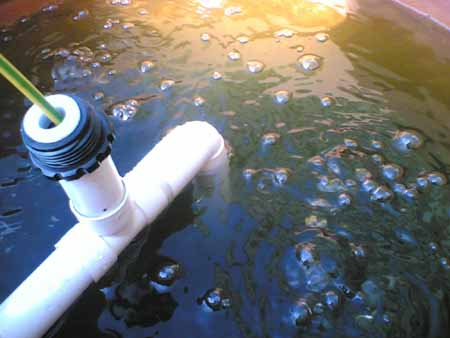
To the right is the final version of my homemade
DIY mini bio-filter venturi being tested without
the
filter
media in
the tank.
Plenty of bubbles! |
 |
In-Pond Venturis
Normally a venturi is used directly
in the main body of the pond, to provide oxygen and water
movement for
the benefit of the fish (some current to swim into).
However I thought that
a venturi dedicated solely to the bio-filter would
provide it with additional oxygen, which "aerobic
bacteria", vital for a bio-filter to work, require
in order to live and work efficiently.
Some experts don't recommend venturis, as they can be inefficient devices because
it forces the
pump to push water through a restrictive venturi tube. Not
only can the
airflow
produced
usually
be too small unless the device is placed
right at the surface, but the final pump flow rate can be reduced
by as much as
2/3rds! This means you would need a much
bigger pump to power the system than required,
just
to power the venturi. This increases the
initial cost of
the pump, the running costs, and can reduce
the life of the pump. This is true of "in-pond" venturis.
But venturis come in all types and sizes for different purposes. Industrial
strength venturis, pumped using large electric motors for use in reservoirs,
sewage farms, and water treatment plants, down to smaller scale for use
in ponds. Venturis are also used to create the petrol/air mix in petrol
engine carburettors.
When used directly in the pond, a venturi does require a considerable force
to create good water movement, and a reasonably high pressure to "squeeze"
the water and air together so making thousands of very fine tiny bubbles.
Click here for a more heavy-duty
venturi design specifically for use directly in the pond.
Note: My venturi is intended to help oxygenate
the bio-filter, not the pond.
You might
consider having a seperate larger venturi fed from
another pump dedicated
to pond aeration itself, I do. To understand why it is
a good idea, learn a little more about oxygenation at
this
link:
http://home.att.net/~oxymax/aerate.htm
 Top Top
Mini Bio-Filter
Venturi
For my purpose I don't want a powerful jet pushing
into the bio-filter because it would disturb the filter
media too much. All I need is a gentle
flow of water with air bubbles, 24 hours a day, to help improve the oxygen
level in the bio-filter. However the pressure in the
device has to be sufficient
to create the "venturi" effect in the first
place.
Alternatively I could have purchased an electric air-pump, a length of
tubing and a couple of air-stones to put in the bottom of the bio-filter.
However,
a venturi can be contructed easily, for virtually no cost, and has no moving
parts to wear out, while an air-pump would have been another £10 or £20
depending on its size.
Since I had some piping left over after building
my homemade bio-filter I thought I would give it a go.
After building my venturi
I agree that the pressure has been reduced, but only very slightly, more
like just one quarter. My waterfall and stream which are gravity
fed from the bio-filter, still have a nice convincing flow (at the time
using a Hozelock Cascade 4000 mains powered pump - 4000 litres/hour).
Water Turnover
& Pressure Points
The most important thing to remember with waterfalls
and venturis is that it is not only the stated flow rate
which is important, but the
wattage of the pump. There is a
big difference between a 2000 galls/hour flow rate @
95 watts and a pump delivering 2000 galls/ hour @ 220
watts. The former
is classed as a water mover, and whilst excellent for filtration flow,
may not have sufficient power for a venturi or waterfall where back pressure
and head are significant factors. The second pump mentioned would deliver
the rated flow, overcoming back pressure and would pump up to considerable
heights as it is more powerful, but of course more expensive to run.
My pond is only about 400 gallons (as mentioned before I am not a large-scale
koi-keeper, I just want to improve the quality of my water). The Hozelock
Cyprio Cascade pump
I originally used can pump 4000litres per hour (or 880 gallons per hour)
at its maximum rated capacity, and 616 gallons/hour at 1 metre head.
My new Hozelock Titan
Solids Handling Pump can push 8000 litres/hour, and this powers my new
DIY pre-filter,
venturi and bio-filter, and also has a bypass
valve going to the top of my waterfall.
Top Design Ideas
The venturi detailed here went
through several test phases and rebuilds before it was
functioning as desired.
I will show you the final design first, then later on
I go over the earlier prototypes which didn't make the
grade, and why they didn't work!
First I started out searching the Internet for information
on how a venturi is constructed.
I came across the following
page and basic design which I tried out first:-
http://www.whom.co.uk/pond/venturi.htm
The design looked simple enough, but I found that my
pump pressure was too weak for the size of piping suggested
(3/4" pipe),
because really the purpose of the venturi suggested at
the above site is intended for a good strong flow into
the pond itself.
I also found the following novel illustration of
the principles and pressures involved in venturi design,
and although
probably beyond our humble purpose of pond water aeration
(it is aimed more at engineering techniques for
precision venturis
and
demonstrates
the mathematics and pressures), it is quite interesting
to look at because it is
an interactive Java Applet which you can play around
with! Give it a go!
http://www.ce.utexas.edu/prof/kinnas/319LAB/Applets/Venturi/venturi.html
With kind permission and courtesy of
Prof. S.A. Kinnas, Ph.D., Ocean Engineering - Ocean Eng.
Group, EWRE, Civil Engineering, University of Texas,
Austin.
During the first three weeks of my bio-filter being
in action it didn't really get much chance to build up
any bacteria. I just wouldn't leave it alone, because
I was taking it to pieces every 3 or 4 days to experiment
with
different
configurations
of piping and air-inlet
pipe sizes in my efforts to get the venturi operating
nicely.
How to build the Venturi
The final configuration is as
shown in the diagram below. It is fashioned out of 22mm
UPVC water pipe, with a corresponding
22mm T-piece. The central cone shaped "restrictor" hole
is fashioned out of - wait for it - plasticine!
Yes, I used ordinary kids plasticine because it was dead
easy to mould while
warm,
and yet when it
is cooled by the water it becomes stiff enough not to
lose shape.
The restrictor hole cone shape was carefully formed
in the plasticine by using a 10mm drill bit hand held
(not
in
a drill!),
first by rotating in a drilling fashion to make the initial
hole straight through. This had to be done in small stages
because the plasticine sticks to the drill bit, so you
have to
drill a little, remove and clean the bit, and repeat
several times until you're through.
Next, again using the drill bit, constantly and
slowly rotated, held loosely in your fingers, rotate
it in a circular conical
see-saw kind of motion with
its
axis at
the centre
of
the T-piece,
so that the plasticine is slowly squished out from both
ends and then excess carefully cut off with a modelling
knife. You
have to
be careful to make sure the excess plasticine is trimmed
sufficiently far back into the T-piece because if you
don't, when the 22mm piping
is push-fitted into the T-piece, it will
squish the plasticine in again so ruining the shape of
the cone just created. You may have to repeat the process
several times:- mould, shape, trim excess, until you
are happy with it.
I would recommend not making the middle aperture larger
than 10mm initially,
so that the increase in pressure causes the velocity
of the water to be quite fast as it goes through and
passes the air-intake, so causing a good strong vacuum.
Its easy to squish plasticine out, but not so easy to
put it back in again without having to totally remake
the restrictor. Only if the water pressure
is reduced too much on the exit side should you consider
increasing the diameter of the restrictor bore. It is
surprising how much volume of water can pass through
the venturi under pressure.
The air-intake pipe is made from electricians yellow/green
coloured earth-sheathing tubing normally used to cover
the earth-wire in domestic
electric switch and socket connections.
It was about the only kind of tubing that I could find
readily to hand that was thin enough (about 3mm diameter)
to cause a nice draw
of air.
This
is because the vacuum in the venturi has to overcome
the
backpressure
of the water trying to go up the tube. The bottom
of the tubing was cut at a slight angle (about 20 degrees)
to match the cone
angle of the moulded plasticine, and it must be positioned
exactly flush with the cone shape of the venturi for
maximum effect. Again drilling through the plasticine
vertically to accomodate the earth-sheathing is a bit
tricky, because it squishes the plasticine out of shape
again, so you might have to do some re-forming of the
cone shape again, but this time with the air-intake pipe
in place, while being careful that the plasticine does
not get into the narrow air-intake pipe and block it
up.
The plasticine is a little tricky to work with, but with
patience you can do it. And like this you can re-form
it until you have the best size and shape for it to work
nicely.
Once you know what works you can, if required,
re-fashion the venturi cone out of something more permanent
like epoxy-resin. I did consider doing it with epoxy-resin
at the start, but then I thought about the problems involved;
- How would you form the resin into the correct
cone
shape
before
it sets?
- Alternatively you could fill the T-piece completely
with epoxy-resin to make a solid lump and drill after
it
has hardened,
but then
how
do you
drill
a nice smooth cone shape in the resin if you don't
have engineering tools?
- How do you put epoxy into the T-piece without getting
it all gunked on the inside which after it has hardened
would cause problems pushing the 22mm piping into the
T-piece? We all know how incredibly sticky and stringy
epoxy resin can be while working it, and how hard it
is once set!
My main objective in creating the venturi was to try
different things out until they worked, and what simpler
way than to use good old plasticine? And if it works
- well don't knock it!
Anyway after 2 years of use, so
far the plasticine version
has functioned perfectly well, and also operates far
better at lower pressures or deeper water than Zik's
venturi design, while Zik's is a real water mover and
mixes air into the water more efficiently.
The pre-filter prevents
any large solid particles going through the venturi which
might block or mess-up the shape of the plasticine.
Inspect the design diagram below and note the following very
important points to ensure the venturi works:-
- The air-intake must be positioned
on the exit side
of the restrictor just after the narrowest section
of the restrictor, not in
the centre of it.
- VERY IMPORTANT: The air-intake should be
quite narrow (about 3mm) in comparison to the water
inlet (22mm) and the bore of the restrictor (approx
10mm), so
that
the vacuum on the exit side of the restrictor can act
easily to pull air in. This is the main mistake people
make when constructing a venturi. The larger the
diameter of the air-intake pipe, the faster must
be the flow of water through the venturi, especially
if you want it to pump into deep water.
- The air-intake must be cut at a slight angle (about
20 degrees) to match the cone shape.
- The more narrow the bore of the restrictor is (start
with about 8-10mm), the faster will be the flow of
water through the restrictor
resulting in a more powerful vacuum to suck air down
the air-intake pipe, but the trade-off will be less
water pressure out of the venturi into the bio-filter
(this isn't a bad thing since we want a controlled
flow through the bio-filter to give it enough Retention
Time for bacteria to work), but this might also mean
any water feature following on would not look very
effective and it could put a strain on the water pump.
Diagram
of How a Venturi Works
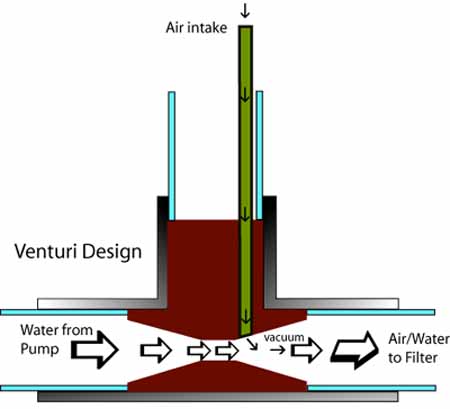
Figure 1. Venturi design.
Top Finished Venturi
The picture below shows
the final venturi design in operation and as can be seen there are plenty of
bubbles being output from the swirler at the bottom of
the bio-filter. The black cap is just a suitably sized
threaded cap fitted to the top of the 22mm pipework to
protect the innards of the venturi.
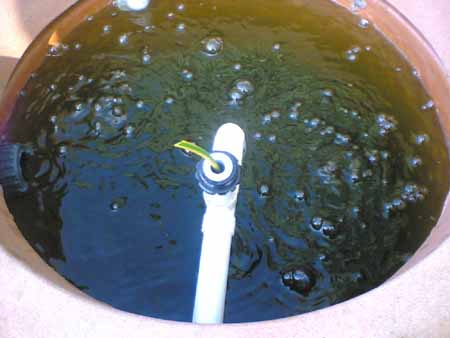
Obviously the air-intake tube should
not be pushed or pulled because it relies on the plasticine
holding it in place, and its location in the venturi
is critical. However as I explained it has now been in
operation for 2 years with no problems. These pictures
show the bio-filter with the filter media
removed
for
testing.
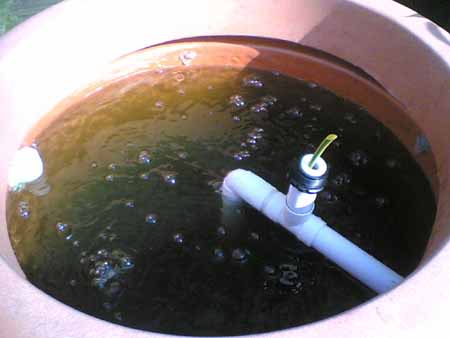
And here it is with filter-media replaced,
and the air bubbling up nicely through the media. In my
earlier designs I had the venturi at the bottom of the
bio-filter tank (see pics further below). Now with
it at the top, it is much easier for me to remove it
for
inspection
and
cleaning,
or even
to upgrade to a better design if necessary.
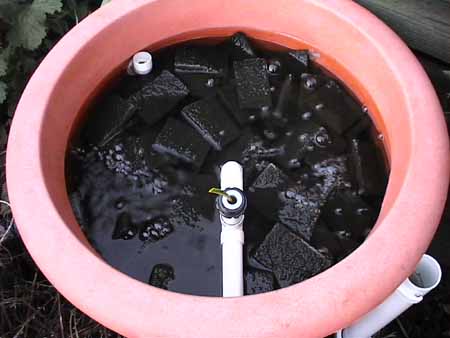
With the finished design, after flushing out my bio-filter
as a part of routine cleaning maintenance, when I turn
the pump back on again there is some slight spouting
of water out
of the
air-intake
pipe
due
to
large
bubbles
being pumped through from the pre-filter, but as the
air bleeds out of the system and it settles down the
venturi effect starts to work and pulls the air in properly
giving a constant sucking sound and air bubbles are properly
fed down into the bio-filter. So when you start it for
the
very first
time, expect it to act a bit like a "coffee perculator"
until the air in the pre-filter and piping has bled through
and out!
Put your ear next to the air-intake and you should hear
a constant draw of air into the venturi, and of course
should see the bubbles rising to the surface.
Top Earlier
Prototypes - What didn't work!
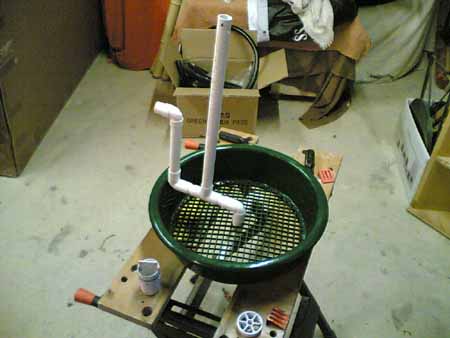
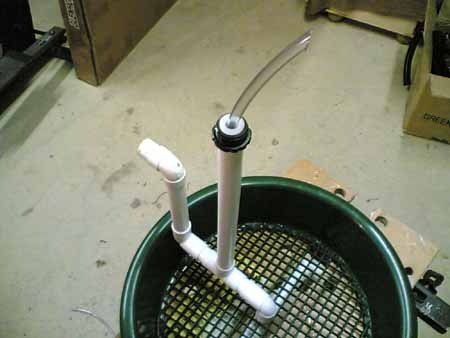
This picture shows the very first design
with the venturi T-piece positioned right near the bottom
of the bio-filter, with a long upriser tube.
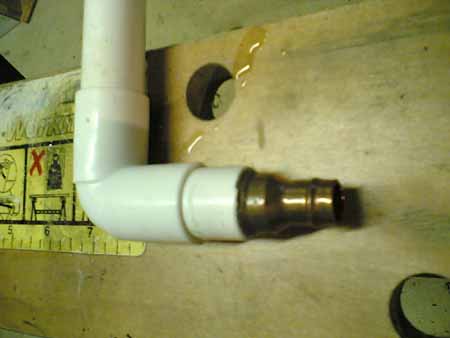
The first venturi design was attempted
with a piece of copper tubing normally used to convert
22mm pipework to 15mm. It was glued in place with Fernox
jointing compound.
When the T-piece was fitted on it was
pushed on only far enough so that the narrow end of the
copper converter was halfway through, so that a length
of plastic tubing could be pushed down in front of the
opening.
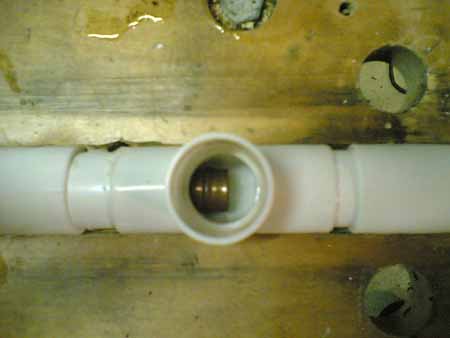
Another view.....(note that there is
nothing else to fill/block this pipe or hold the narrower
air-pipe in place - this was a mistake and one of the
reasons
why this design didn't work for me initially).
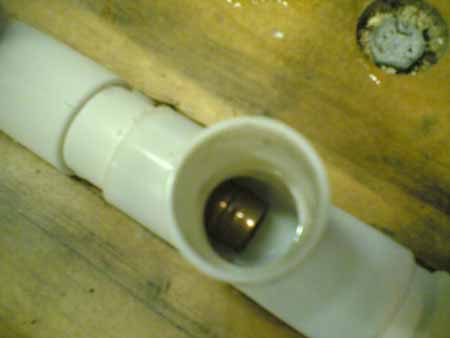
Looking into the exit or outflow end
of the T-piece (below) you can see the plastic tubing
in place, with its end cut at an angle and facing with
the
direction
of the water flow (the water comes out of this end). 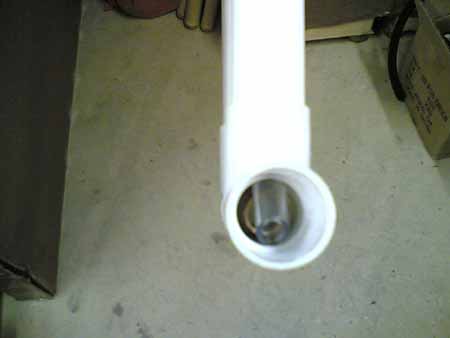
Below is the complete assembled (non-working!)
venturi.
Top Back to the Drawing Board!!
Well the initial prototypes didn't work.
There were several factors causing these designs to fail:-
- The force of the water exiting from the copper tube
was insufficient to create enough vacuum to suck the
air down the clear plastic air-intake
tubing. When the water was turned on and the bio-filter
started
to fill, it was drawing air in as expected, But as the tank started
to fill, the level of water became higher, until eventually
the vacuum was unable to overcome the backpressure
of
the water as it was trying to go up the
air-intake tube instead!
- There was nothing surrounding the air-intake tubing
at the bottom of the 22mm pipework where it entered
the T-piece, therefore nothing blocking and preventing
water from rising up and around the air-intake tube
inside the 22mm pipework. So the vacuum was also having
to pull the water down in the main 22mm riser tube
as well. It just wasn't going to happen!
- The clear plastic tubing was too wide, so again the
vacuum had too much volume of water to pull down the
air-intake before it could even start drawing air in.
- The copper tubing did not narrow enough, and didn't
form any decent union with the air-intake pipe, which
just flopped around in front of it with nothing to
hold it in place.
- All of these were exascerbated by the depth at which
the venturi T-piece was located, about 12 inches underwater.
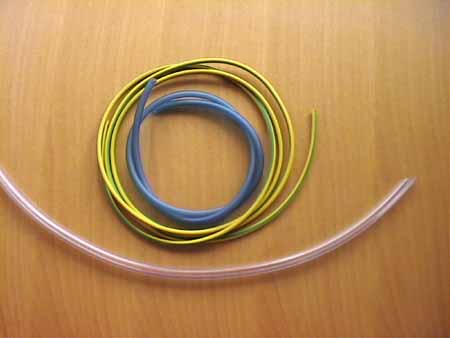
Three different types of tubing were tried. 8mm clear
plastic tubing. 6mm tubing (blue), and finally electric
Earth-sheathing which is about 3mm diameter.
With my earlier
designs when I was testing them out (the ones that didn't
work very well) I was listening
with my ear right next to the air-intake to hear how
well it was working, and you guessed it - I got an ear
full of pond water! LOL.
Even though the Earth-sheathing was
attempting to work better, it would once again stop
as the filter filled up and the depth of water increased.
Bear in mind that in this design there was still nothing
to block the water coming up the main riser tube. i.e.
there was NO plasticine in this model.
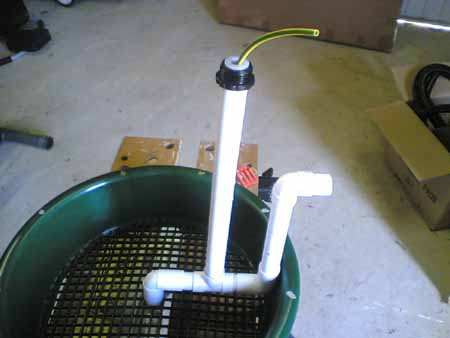
So it was a case of "back to the
drawing board" to have a rethink about the problems,
and come up with a better design.
Top
Was it worth it?
The final design shown at the start of this page works
quite well. No doubt there is room for improvement, but.....
During the first 2 weeks of experimenting the bio-filter
didn't really get much chance to settle down, what with
me pulling it apart every couple of days to re-arrange
the venturi. It is said that a bio-filter requires about
6 to 8 weeks
to
mature,
while the bacteria builds up, and a balance is created
in the ponds eco-system.
In the third week, with the early prototype venturis
not working very well, there was very little happening,
and
while
the water was beginning
to
look
cleaner due to the pre-filter, it
was
still VERY green.
But in the fourth week, about 4 days after I
got the final venturi design working mixing air into
the water
nicely, the water was starting to clear noticeably. Up
until
now
the fish
could
only
be seen clearly if they came within about 3 inches of
the surface, any deeper and they became a green blur.
But after 6 days of oxygenating the water going into
the bio-filter the fish could be seen progressively deeper,
now down to 6 to 8 inches, and the vivid green was weakening.
Now about 8 weeks after the whole bio-filter and venturi
setup has been fully operational we can once again see
our fish. The water is much clearer and cleaner. The
bio-filter has healthy looking gunk in it, and the pre-filter
does not seem to be blocking up as quickly - I still
clean it regularly, but there is just not as much build-up
of muck in it.

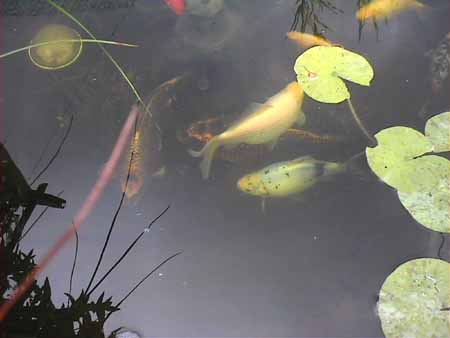
Now my pond is back to normal, with visible fish,
thats a novelty!! And done the natural way without
chemicals or ultra-violet lights. The big ghost-koi
in the right hand picture is right at the bottom
of the pond about 30 inches deep. |
 |
Another advantage of having the venturi just before
the bio-filter is that if the pump is turned off, either
for maintenance or due to power failure, it prevents
syphoning back into the pond, because the
air is drawn back down the pipe rather than the water,
so immediately
killing any syphoning effect. This is good on two counts;
1) it prevents any sediment held
in the
settlement
chamber
from backwashing right back into the pond, and 2) the
bio-filter will not accidentally empty, so keeping
the bacteria in water which although not flowing will
at
least keep the bacteria alive for a few hours until
water flow is restored.
The success of the whole setup is not down to any one
thing. It is a combination:-
- Re-adjusting mental attitude for regular cleaning
of filters
- Oxygenating/aerating the water has a very positive
effect on water quality, and efficiency of aerobic
bacteria in the bio-filter
- Feeding the fish only as much as is required
- Cleaning other muck out such as leaves to minimise
decaying matter
- Adding nitrate loving and oxygenating plants to increase
bacteria breeding surface area elsewhere in the pond,
and reduce the level of nitrate available to phyto-plankton.
This is a continuously evolving project, and I have
made some alterations to my setup. To
read about the modifications I have made to my venturi
in 2005 click
here.
If you have any comments or suggestions about this project
please contact me:
And if you have found these web pages useful and interesting and would like to
make a donation, you may do so using the Donations
Page.
Top
 |


